Section 3.2 · Further exercises · 6 of 10
Exercise 3.2.6: Sphere with a decreasing charge density
About the further exercises of Section 3.2
Ten further exercises in the spirit of Problems 3.2.1–3.2.5 and the home exercises. All of them use Gauss's law in its integral or differential form,
together with symmetry and, where useful, superposition. Exercises 3.2.1–3.2.2 have cylindrical symmetry, Exercises 3.2.3–3.2.4 planar symmetry, and Exercises 3.2.5–3.2.9 spherical symmetry (or a symmetry argument of another kind), while Exercise 3.2.10 checks the law for a field without any symmetry.
Sphere with a decreasing charge density
#cf. Home exercise 3.2.2
A sphere of radius carries the volume charge density , where is a constant. (a) Find the total charge. (b) Find inside and outside. (c) Where inside the sphere is the field largest, and what is its value there?

Spherical symmetry, with the enclosed charge an integral over thin shells . For part (c) set inside.
For a spherically symmetric density the volume element can be taken as the thin shell (the angular integrations give ):
The charge inside a Gaussian sphere of radius is
and equating with (and using for ),
Inside,
at , and the second derivative is negative, so this is a maximum:
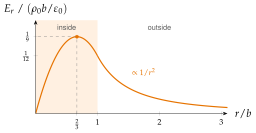
At the surface from both expressions, which is smaller than : because the density falls to zero at the surface, the field peaks inside (Figure 3.2.30). Compare Home exercise 3.2.1, where the uniform sphere has its largest field exactly at .