Section 3.2 · Problems · 1 of 5
Problem 3.2.1: Infinitely long line charge
Infinitely long line charge
#Find the electric field at a normal distance of from an infinitely long line charge with a uniform charge density of by using Gauss's law.
Source: D. K. Cheng, Field and Wave Electromagnetics, 2nd ed., Example 3-5.
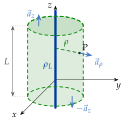
An infinite line has cylindrical symmetry, so the field is radial and depends on only. A coaxial cylinder through P is then a Gaussian surface: is normal to its side with constant magnitude, and tangential to its caps.
The infinite line is unchanged by a translation along its own axis () and by a rotation about it, so the field cannot depend on or : it depends on only. It is also unchanged by the reflection through the plane perpendicular to the line that contains the field point P, which would reverse a component, hence . Finally, it is unchanged by the reflection through the plane that contains the line and P, which would reverse a component, hence . The field is radial and its magnitude depends on only:
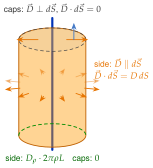
For the left-hand side of Eq. (3.2.13) we take a cylindrical surface of radius , coaxial with the line, from to ( to be taken to infinity later). It consists of three parts (Figure 3.2.16a):
- the side, where and is constant, so that , and
- the top and bottom caps, where is perpendicular to , so that .
Only the side contributes:
The cylinder contains a length of the line:
Equating both sides,
The length has cancelled, so letting has no effect on the result, and we find
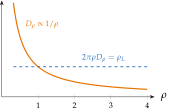
Units: is . This is the result of Problem 3.1.1, obtained there by integrating along the whole line. Here symmetry does the work: the flux per unit length through every coaxial cylinder is , and since the area per unit length of the cylinder grows as , the field falls as . Note that the infinite length was essential: for a finite line the field is not purely radial and is not constant on the side of a cylinder, and Gauss's law cannot be used to compute it.