Section 3.2 · Problems · 5 of 5
Problem 3.2.5: Spherical shell with volume charge
Spherical shell with volume charge
#By using Gauss's law, find the electric field in the regions , and regarding the spherical shell with an inner and outer radii of and , respectively. Note that the spherical shell carries a uniform volume charge density of .
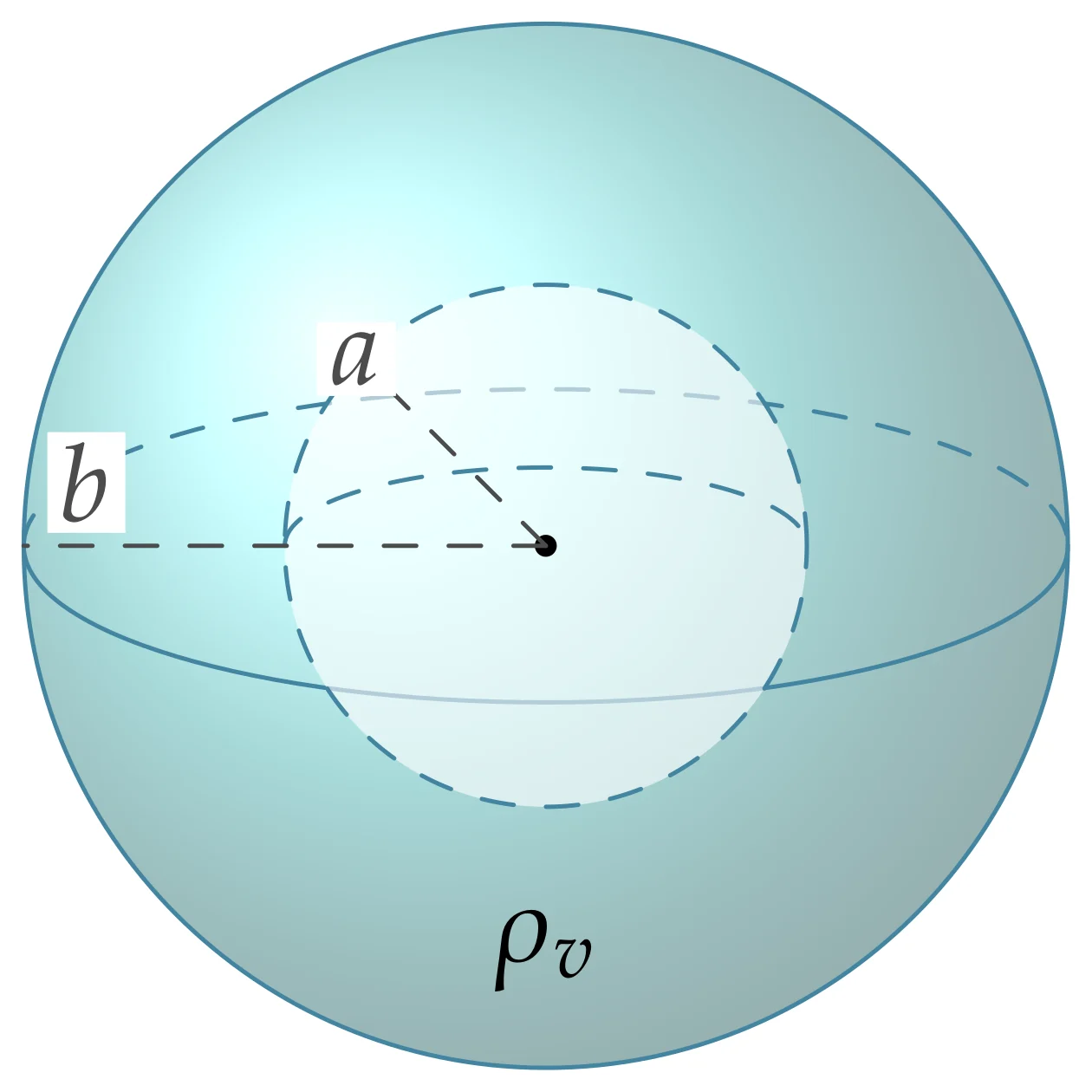
Spherical symmetry: the field is radial and depends on only, so a concentric sphere is a Gaussian surface. One sphere, drawn with three different radii, serves all three regions, and only the enclosed charge (a volume of the shell times ) changes.
The charge distribution is unchanged by every rotation about the centre. The field must therefore be radial (any tangential component would single out a direction on the sphere) and its magnitude can depend on only:
We take a sphere of radius concentric with the shell (Figure 3.2.21). On it
with constant on , to give
The same Gaussian sphere, drawn with three different radii, serves all three regions. Only the enclosed charge changes.
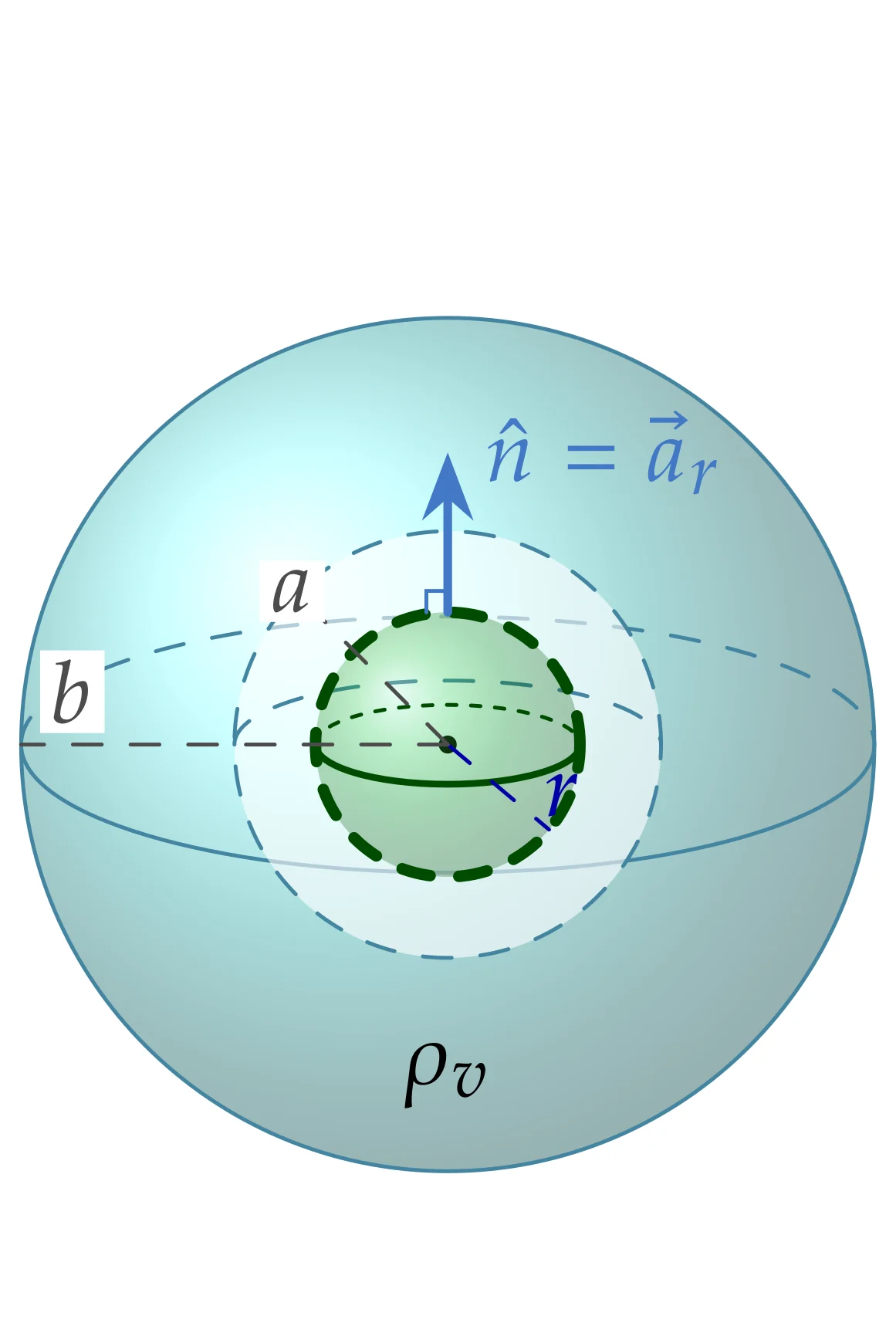
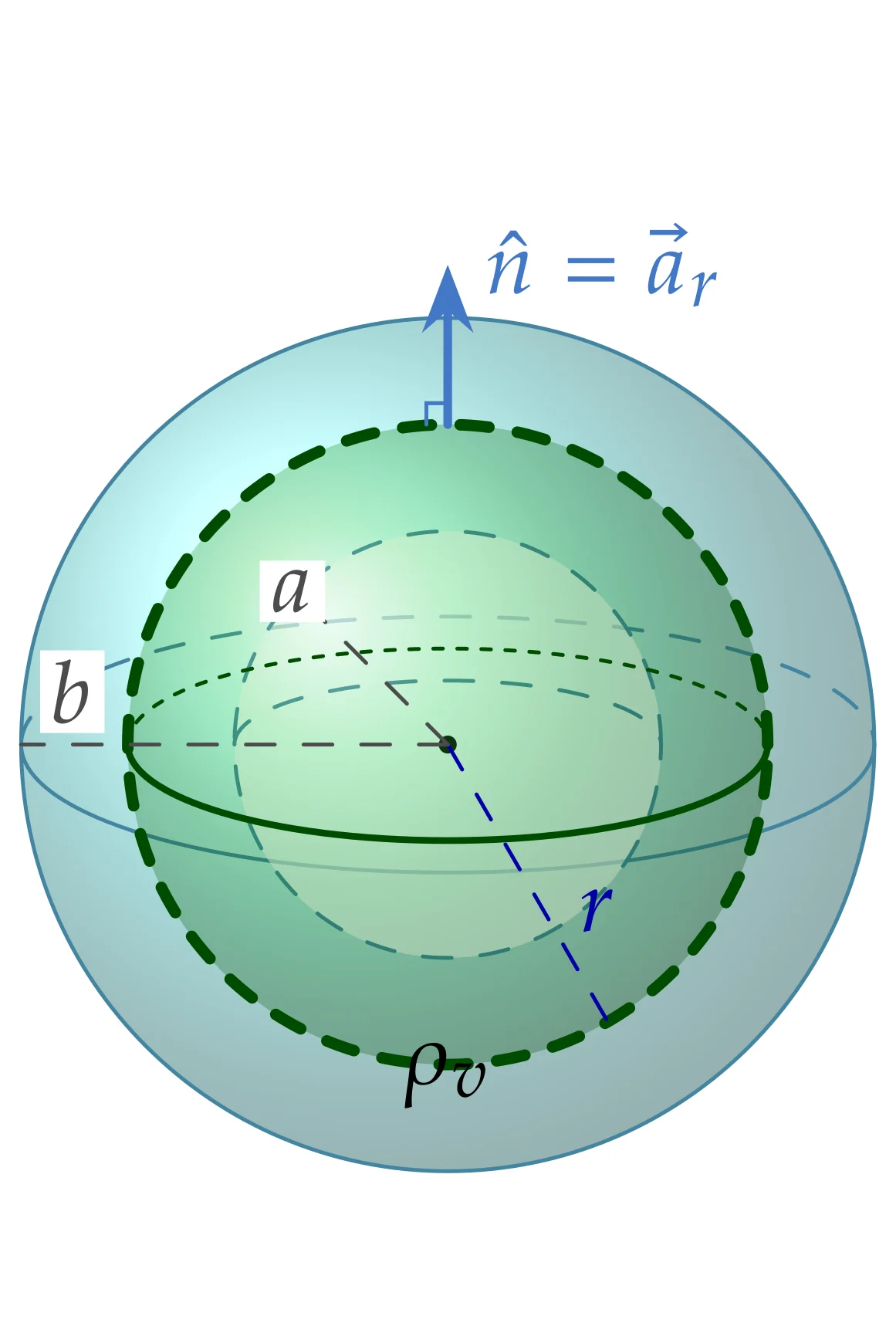
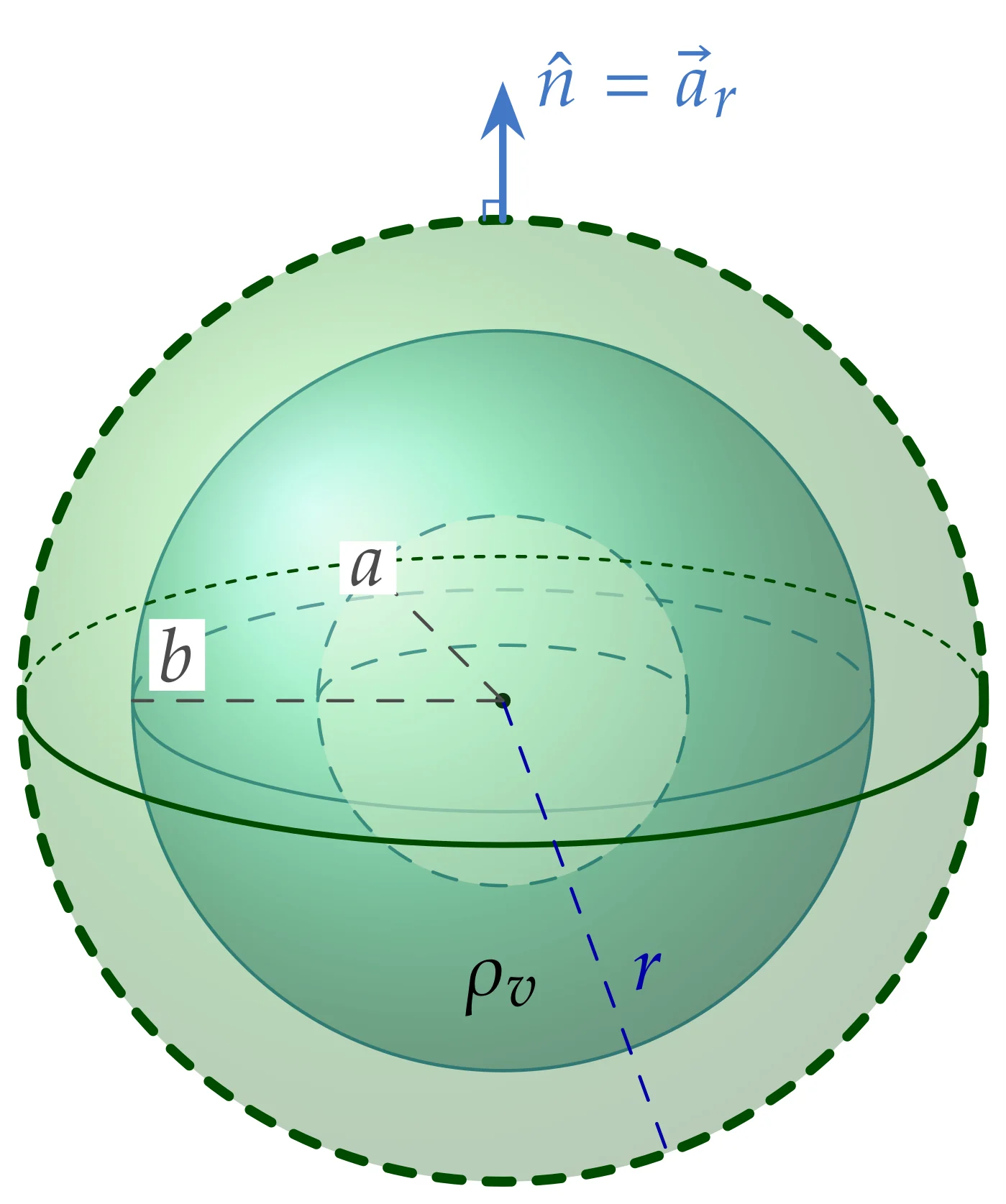
The Gaussian sphere lies in the empty cavity,
which gives
The Gaussian sphere encloses the part of the shell between radii and , whose volume is :
Equating both sides,
The Gaussian sphere encloses the whole shell,
and equating both sides,
So we find
where, for ,
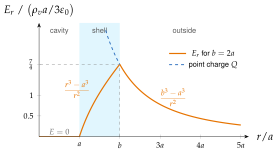
Change the radii and the charge density below and watch the field profile: zero in the cavity, rising through the shell, and the field of the total charge outside.
is continuous at (both expressions give ) and at (both give ): there is no surface charge, so no jump. The field rises through the shell, peaks at and outside equals the field of a point charge at the centre (Figure 3.2.22): a spherically symmetric charge distribution looks, from outside, like a point charge. The field in the cavity is zero whatever the thickness of the shell. With the result becomes the uniformly charged solid sphere of Home exercise 3.2.1.