Section 3.2 · Further exercises · 1 of 10
Exercise 3.2.1: Two coaxial charged cylinders
Ten further exercises in the spirit of Problems 3.2.1–3.2.5 and the home exercises. All of them use Gauss's law in its integral or differential form,
together with symmetry and, where useful, superposition. Exercises 3.2.1–3.2.2 have cylindrical symmetry, Exercises 3.2.3–3.2.4 planar symmetry, and Exercises 3.2.5–3.2.9 spherical symmetry (or a symmetry argument of another kind), while Exercise 3.2.10 checks the law for a field without any symmetry.
Two coaxial charged cylinders
#cf. Problem 3.2.2
Two infinitely long coaxial cylindrical surfaces of radii and () carry uniform surface charge densities and , respectively. (a) Find in the regions , and . (b) What relation between and makes the field outside vanish?
Source: D. K. Cheng, Field and Wave Electromagnetics, 2nd ed., Problem P.3-12.
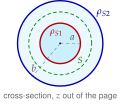
Cylindrical symmetry: one coaxial Gaussian cylinder of radius , placed in each of the three regions in turn. Each charged surface contributes its charge per unit length (radius) once the Gaussian cylinder encloses it.
Gauss's law, Eq. (3.2.13), on a coaxial cylinder of radius and length . By symmetry , the caps contribute nothing, and
For the right-hand side, the enclosed charge is for , for , and for . Equating both sides in each region:
The field outside vanishes when the total charge per unit length, , is zero:
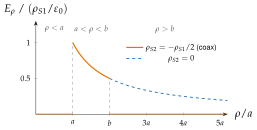
At each surface the field jumps by : at from to , at by . This is the charge distribution of a coaxial cable: equal and opposite charges per unit length on the two conductors confine the field to the space between them (Application 3.2.2, Figure 3.2.26). The outer surface charge density is smaller in magnitude than the inner one by the factor , because the same charge per unit length is spread over a larger circumference.