Section 4.3 · Topic 1 of 10
4.3.1 From Ampère's law to a circuit
The circulation of H along a closed path
The first fundamental equation of magnetostatics, Ampère's law of Section 4.1, says in integral form that the circulation of around any closed path equals the current through any surface bounded by :
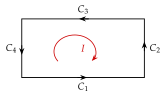
The path may be cut into pieces. For the rectangle of Figure 4.3.1, made of the four sides , , and taken in order, the circulation is the sum of four line integrals,
where is the current linked by the rectangle, counted positive when it circulates in the sense given by the right-hand rule with respect to the direction of travel along . This trivial-looking split is the whole idea of the magnetic circuit: when the path runs along an iron core, each side of the rectangle will be one branch of the core, and each line integral will become a simple product .
Flux lines do not end: the node rule
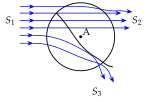
The second fundamental equation, for every closed surface (Section 4.1), is the statement that lines of have no beginning and no end. Figure 4.3.2 shows a bundle of flux lines near a point A where the bundle splits. Wrap a closed surface around A and divide it into the three parts , and through which the lines pass. With the outward normal, the flux entering through is counted negative and the fluxes leaving through and positive, so
In words: what flows in must flow out. This is the magnetic version of Kirchhoff's current law, and in a core it will apply at every point where the iron branches.
Two rules and nothing else: going round a closed path, the pieces add up to the current linked, and at a junction the fluxes add up to zero. The first is Ampère's law, the second is "flux lines do not end".