Section 3.1 · Topic 3 of 10
3.1.3 Coulomb's law
In 1785 C. A. de Coulomb measured, with a torsion balance, the force between two small charged spheres. The result is the second electromagnetic assumption of Table 3.1.1, and we state it in the form in which we shall use it.
Let two material points with charges and be fixed in vacuum at a distance from each other. Then, in addition to Newton's gravitational attraction, each exerts on the other a force directed along the line joining them, proportional to : repulsive when and have the same sign, attractive when their signs are opposite. When more charged particles are present, the total force on any one of them is found by superposition, i.e. by adding vectorially the forces exerted by each of the others separately.
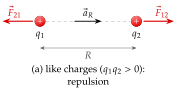
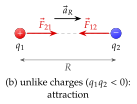
With the notation of Figure 3.1.4, the assumption is written as
Here denotes the force applied by on , is the distance between the charges and is the unit vector pointing from towards . Let us read the formula slowly, one piece at a time.
- Direction and sign. If the force on is along , away from : like charges repel. If it is along : unlike charges attract. The sign of the product does all the bookkeeping, so we never have to decide "attractive or repulsive" by hand.
- Action and reaction. : the two forces are equal in magnitude, opposite in direction and lie on the same line, in agreement with Newton's third law.
- Inverse square. Doubling the distance reduces the force to one quarter, so the dependence on is exactly that of Newton's gravitation.
- Medium. The law refers to charges in vacuum. In air the force is smaller by only about , so the vacuum formula is used for air as well. Material media are treated in Section 3.4.
Two charges push each other apart if they have the same sign and pull each other together if their signs differ. The push or pull acts along the line joining them, is the same size on both, grows with the product of the charges and falls off as one over the distance squared.
Drag the two charges and change their values: the force arrows on both charges stay equal and opposite, and doubling the distance cuts them to a quarter.
Two small charged spheres apart repel each other with . What is the force (a) at , (b) if one charge is doubled and the distance is doubled to ?
(a) Three times the distance gives of the force: . (b) The factor from the charge and from the distance give : . Both are still repulsive.
The vector form with position vectors
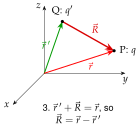
In most problems the charges are not conveniently placed on an axis, and it is better to describe them by their position vectors (Section 2.3). We build the vector between the two charges in three small steps (Figure 3.1.5).
- The source charge sits at the source point Q. Its position vector, drawn from the origin O to Q, is .
- The charge on which we want the force sits at the field point P, with position vector .
- The vector from Q to P is the one that closes the triangle: going from O to Q and then from Q to P is the same as going from O to P, so .
Solving the last relation for gives the displacement vector
and its unit vector is . A useful way to remember the order: is "where we look minus where the charge is".
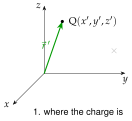
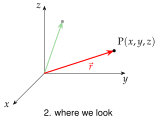
Since , Coulomb's law (the force exerted by on ) takes the three equivalent forms
The form with looks like an inverse cube law, but it is not: the numerator has length , so . It is the most convenient form for calculation because is written directly in components, with no square root in the numerator.
Writing (from the field point to the source) flips the sign of every component and turns repulsion into attraction. Always "field point minus source point": , and check with a picture that the arrow starts at the charge.
A charge sits at and the field point is (in metres). Write and .
and . The vector points from Q to P.
The constant ε₀ and the unit of charge
In SI units force is measured in newtons, distance in metres and charge in coulombs [C]. The proportionality constant is written as . The factor is included here so that it disappears from the more frequently used equations (Gauss's law, the capacitance formulas) later on. The constant is the permittivity of free space,
This is the value of Eq. (1.4.2) in Chapter 1, and all numerical examples in this book use it. It follows from with and the speed of light taken as . With the exact value of one obtains , which differs by only about , a difference that is negligible in engineering. Let us check the units. With in F/m C/(V·m),
Eq. (3.1.5) also gives a feeling for the size of one coulomb: two point charges of each, placed apart in vacuum, repel each other with a force of , roughly the weight of a million tonnes. One coulomb is therefore an enormous amount of static charge, and the charges met in electrostatics are typically nanocoulombs to microcoulombs.
Coulomb's force is not only stronger than gravity, it is incomparably stronger. For an electron and a proton at any distance (both forces are inverse-square, so the distance cancels),
This is why the gravitational attraction mentioned in the assumption can always be ignored between charged particles. Gravity dominates on the scale of planets only because large bodies are almost exactly neutral.