Section 3.1 · Topic 5 of 10
3.1.5 The superposition principle
A system of point charges
Coulomb's assumption contains, besides the inverse-square law for two charges, a second statement: when several charges act on one charge, the forces simply add. The presence of the other charges does not modify the force that any one of them exerts. This is the superposition principle. It is an experimental fact, and it is what makes electrostatics a linear theory: double all the sources and every force doubles, and adding a second set of sources simply adds its forces to the old ones.
A numerical illustration
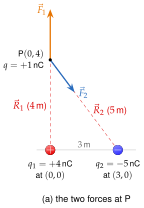
Before writing the general formula, let us add two forces by hand. A charge sits at the origin and a charge at . What force acts on a small charge at ? We use and treat the two sources one at a time (Figure 3.1.13).
-
Force of . , , so
It points straight up, away from (both charges are positive: repulsion).
-
Force of . , , so
It points from P towards (unlike charges: attraction). Its magnitude is .
-
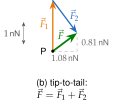
Total. Adding component by component,
Notice that is much less than : the two forces partly cancel because they point in different directions.
The general formula
Now consider point charges at the source points , and a charge at the field point (Figure 3.1.14). Let be the displacement vector from to , its length and its unit vector. By Coulomb's law (3.1.7) the charge alone would exert on the force . Superposition says that the total force is the sum of these contributions:
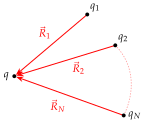
The sum is a vector sum: each term has its own direction, and in practice we add the -, - and -components separately, exactly as in the numerical illustration. The second form, with , is again the most practical one because each is written directly in Cartesian components.
Each charge pushes or pulls on as if it were alone. To get the total, draw all these arrows and add them tip to tail, or, more reliably, add their -, - and -components.
Move the three charges and watch the force on each one: it is always the tip-to-tail sum of the two pair forces acting on it, never the sum of their magnitudes.
Forces are vectors. Adding the magnitudes, , is wrong unless the forces happen to be parallel. In the illustration above it would give instead of . Add components.
Three equal charges sit at the corners of an equilateral triangle. What is the total force on a fourth charge placed at the centre of the triangle?
Zero. The three forces have equal magnitudes (equal charges, equal distances) and directions apart, so placed tip to tail they close a triangle.
Continuous distributions: line, surface and volume sources
What if the source charge is not a set of points but a continuous distribution? We use the same idea three times over:
- Chop the distribution into small elements, each so small that it can be treated as a point charge located at its source point .
- Apply Coulomb's law to each element: it contributes a force given by (3.1.7) with .
- Add up: the sum over all elements becomes, in the limit of infinitely many infinitely small elements, an integral.
The displacement vector from the element to the field point is, as in (3.1.6),
and depends on both sets of coordinates. The geometry is that of Figure 3.1.3.
Line source
A charge spread along a curve with density : the element carries , and the force on a point charge at P is
Surface charge
A charge spread over a surface with density : the element carries , and
Volume charge
A charge filling a region with density : the element carries , and
The three formulas look heavy, but each is just "Coulomb's law for one element, added over the source". Several points deserve emphasis, because they are the source of most mistakes in practice.
- Which coordinates are integrated? The integration runs over the source coordinates only. The field point P is held fixed during the integration, and the result is a function of .
- The integrals are vector integrals. The integrand changes direction from element to element. We therefore always expand in the constant Cartesian unit vectors , take them outside the integral and integrate three scalar functions (Figure 3.1.16).
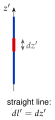
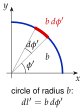
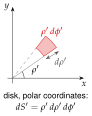
- Use the right element. On a straight line , but on a circle of radius the length of a small arc is , and on a disk the area of a small patch is (Figure 3.1.15, see also Section 2.3).
- Symmetry first. Before integrating it pays to ask which components must vanish by symmetry. Problems 3.1.1 to 3.1.3 show how much work this saves.
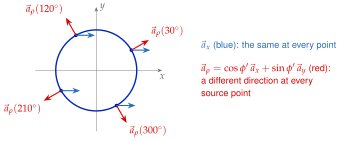
Writing for a full ring is wrong: depends on , and the correct result is . Expand every unit vector that belongs to the source point in before integrating. (A unit vector of the field point, which is fixed, may stay outside.)
On a circle of radius the length element is , and on a disk the area element is . Forgetting the factor or gives a result with the wrong units: a quick unit check catches it.
If P lies inside a volume charge, vanishes at one point of the integration region, and the integrand blows up there. The volume integral nevertheless converges. Surround P by a small sphere of radius and use spherical coordinates centred on P: the volume element is , so near P the integrand behaves like , which is harmless. The contribution of the small sphere is of order and vanishes as . For line and surface charges, on the other hand, the field on the source itself is not defined: it grows without limit as P approaches a line charge, and its normal component jumps across a surface charge (Problem 3.1.3). This is a consequence of the idealisation, not of the physics.