Section 3.1 · Topic 6 of 10
3.1.6 The electric field
Look again at the formulas (3.1.15) to (3.1.19). In every one of them the charge on which the force acts appears only as a factor in front. Everything else depends on the sources and on the position of , but not on itself. Double and the force doubles, while the rest of the formula is untouched. So the force acting on a charge can always be written as
The vector function is called the electric field (or electric field intensity). It is a property of the source charges alone, defined at every point of space whether or not a charge is placed there to feel it. A helpful picture: the sources "prepare" the space around them, and is a map that tells, at every point, which force each coulomb of charge would feel there.

The electric field at a point is the force per unit charge exerted on a stationary test charge placed at that point,
The limit expresses an idealisation: a real test charge exerts forces on the source charges and, if they are free to move (on a conductor, for instance), it disturbs the very distribution we want to probe. A vanishingly small test charge does not. The unit of follows from (3.1.20) as newton per coulomb. Since , the field is usually given in volts per metre, a unit whose meaning will become clear when the potential is introduced in Section 3.3.
The field of a point charge
Dividing Coulomb's law (3.1.7) by gives the field of a single point charge at :
It points radially away from a positive charge and towards a negative one, and its magnitude falls off as (Figure 3.1.18). For a charge at the origin, and in spherical coordinates (Section 2.3) .
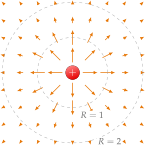
The field of a volume charge
In the case of a volume charge distribution as the source of the force, which is the most general case, dividing (3.1.19) by gives
with and given by (3.1.16). is the force that would act on a unit charge located at the point . Line and surface charges may be regarded as limiting cases of a volume charge squeezed into a thin tube or a thin layer, so (3.1.23) contains the other cases, but we write them out separately in Section 3.1.8.
The electric field is "force per coulomb". Compute it once from the sources. Then the force on any charge is simply that charge times the field. A positive charge is pushed along , a negative one against it.
Why introduce the field at all, when the force is what we measure? Because it separates the problem into two independent parts (Figure 3.1.17): the sources produce a field, which fills space, and the field then acts on whatever charge is placed in it, through . The precipitator, the inkjet and the CRT of Section 3.1.4 are all designed in exactly these two steps. Later in the course, when fields change in time, the field turns out to be a physical entity in its own right that carries energy and momentum.
In a certain region . What force acts on an electron there? On a proton?
. Electron: , against the field. Proton: the same magnitude along . The field is the same, and only the charge that feels it differs.