Section 3.1 · Problems · 3 of 3
Problem 3.1.3: Circular disk source
Circular disk source
#Determine the electric field at a distance above the centre of a circular disk of radius that carries a uniform surface charge density .
Source: D. K. Cheng, Field and Wave Electromagnetics, 2nd ed., Example 3-9.
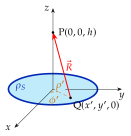
Two routes give the same answer, and we take both. (i) Superposition of building blocks: the disk is a stack of thin rings, each solved in Problem 3.1.2. (ii) The recipe from scratch with a surface source, and . The -integration kills the horizontal components, and the -integration is a standard integral.
Nothing about the disk needs a new idea. Cut it into thin rings (Figure 3.1.27). Each ring is a problem we have already solved, and superposition adds them up. The ring between and has length and width , so it carries the charge . It acts like a ring of radius with line density . By the result of Problem 3.1.2 with and , its field on the axis is
and the whole disk is one integral in from to . The same trick builds a solid cylinder from disks and a sphere from rings: once a simple source is solved, it becomes a building block. This is the superposition principle used twice in a row. Let us nevertheless also carry out the full calculation directly from the definition, as a check.
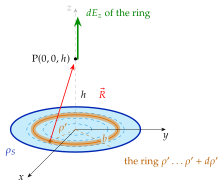
As in Problem 3.1.2, with Q now anywhere on the disk,
In polar coordinates , , so that
With (Figure 3.1.15c, and do not forget the factor ) the electric field at P is
that is
Since and ,
which is precisely the sum of the ring fields found above. With the first standard integral (3.1.30),
and the result is
-
(very close to the disk, or a very large disk): the bracket tends to and
independent of and of . This is the field of an infinite charged sheet, and letting here is the cleanest derivation of the sheet field we have. It does not decrease with distance at all: the farther we go, the larger the part of the sheet that contributes at a given angle, and the two effects cancel exactly.
-
(far away): with the bracket tends to , and
a point charge carrying the total charge, once again.
The curve of Figure 3.1.28 shows exactly where each approximation stops being good. For points below the disk () the symmetry of the disk reverses the field. The general formula is , and crossing the disk at its centre the field jumps from to , a jump of caused by the surface charge.
Units: is in V/m and the bracket is a pure number. Both routes give the same integral. The two limits reproduce the infinite sheet and the point charge, the two results we expect.
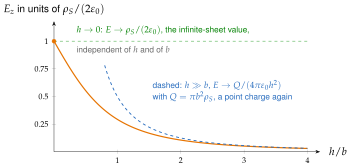
Change the radius of the disk and the height of the field point: close to the disk the field sticks to the sheet value , and far away it joins the point-charge curve.