Section 3.1 · Further exercises · 7 of 10
Exercise 3.1.7: Annular disk (a washer)
About the further exercises of Section 3.1
Ten further exercises in the spirit of Problems 3.1.1 to 3.1.3 and Home exercises 3.1.1 and 3.1.2. Every one is solved with the four steps of Section 3.1.8, and the two standard integrals (3.1.30) appear again and again.
Surface charges
Annular disk (a washer)
#cf. Problem 3.1.3
An annular disk , , carries a uniform surface charge density . Find the electric field at . What happens when ?
Adapted from: B. M. Notaroš, Electromagnetics, Problem 1.25.
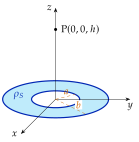
This is Problem 3.1.3 with the lower limit of changed from to . We use the recipe with a surface source, and . The -integration removes the horizontal components and the -integration is the first standard integral (3.1.30). The same result follows from superposition with a negative piece, a full disk of radius minus a small disk of radius , which we use as a check.
The washer is symmetric about the -axis and P lies on it (compare Figure 3.1.27).
- Rotating the washer about the -axis leaves it and P unchanged, so the field on the axis cannot single out a horizontal direction and is along .
- Equivalently, the element at and the one at (same ) give equal and opposite horizontal parts, while their -parts are equal and add.
- All elements on the ring of radius are at the same distance from P, and for every element pushes P upwards, so for .
The source point is somewhere on the washer and the field point is :
In polar coordinates and , with and , so that
The area element is (Figure 3.1.15c, and do not forget the factor ), so and
Separating the components,
where the integrand factorises because the and dependences are separate and the limits are constants.
First the angular integrals, one line at a time:
The - and -components vanish, as predicted in Step 1, and
This is the sum of the fields of the thin rings of radius between and (Problem 3.1.2 with and ). With the first standard integral (3.1.30) (),
and the result is
For the washer becomes an infinite sheet with a circular hole of radius . Then and
The limiting result (Figure 3.1.32) shows what a hole does to the sheet field.
- (P at the centre of the hole): , linearly, . At the centre of the hole the elements all around P cancel in pairs, and the nearest charge is a distance away.
- : , so , the infinite-sheet value. The hole no longer matters.
Superposition gives the same result in another way:
where the bracket is the result of Problem 3.1.3 with . For a washer of finite size, the same expansion with gives and so
the field of a point charge carrying the total charge of the washer.
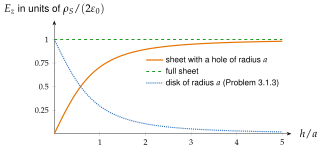
Units: is and is a pure number. Direction: along above a positively charged washer, away from the charge. Limits: for the first result becomes , the result of Problem 3.1.3, and far away it is the point-charge field of the total charge .