Section 3.1 · Further exercises · 5 of 10
Exercise 3.1.5: Semicircular line charge
About the further exercises of Section 3.1
Ten further exercises in the spirit of Problems 3.1.1 to 3.1.3 and Home exercises 3.1.1 and 3.1.2. Every one is solved with the four steps of Section 3.1.8, and the two standard integrals (3.1.30) appear again and again.
Circular line charges
Semicircular line charge
#cf. Problem 3.1.2
A line charge of uniform density lies on the semicircle , , . Find the electric field at , and at the centre of the semicircle.
Source: B. M. Notaroš, Electromagnetics, Example 1.7 and D. K. Cheng, Field and Wave Electromagnetics, 2nd ed., Problem P.3-8.
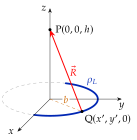
This is Problem 3.1.2 with the range of cut in half, so the element is again and the vector is the one of the full ring. Half of the symmetric partners are now missing, so the symmetry argument has to be redone with care: some components still cancel and others no longer do. We expect a horizontal component pointing away from the charged half. Two points are asked for, the point P on the axis and the centre O, and the centre is the same calculation with written out directly.
Compare with the full ring of Problem 3.1.2 (Figure 3.1.31).
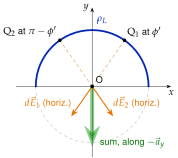
- The mirror plane maps the semicircle onto itself and leaves P unchanged. It exchanges the element at with the one at . These two have the same -part and the same -part, but opposite -parts. So .
- The element at , which cancelled the horizontal part for the full ring, is now missing (it would lie on the uncharged half). Nothing cancels the -parts. Every element lies at and pushes P towards (a positive charge repels), so and it is negative for .
- Every element has a -part of the same sign (it points up from the plane for ), so and positive.
- All elements are at the same distance from P, exactly as for the full ring.
So has the form with and , and the integral only has to give us these two numbers.
The source point is on the semicircle and the field point is :
On the circle we have and , so that
and does not depend on .
On a circle of radius the arc element is (Figure 3.1.15b), so . The only difference from Problem 3.1.2 is the range, :
The denominator does not depend on , and the Cartesian unit vectors are constant, so both come out of the integral:
The three angular integrals are, one line at a time,
The first one confirms the symmetry argument of Step 1 (). Substituting,
With the total charge (the length of the semicircle times the density) and the two components are
The -part is exactly the point-charge field of the whole charge at the slant distance, projected on the axis, and it is exactly half of the -part of the full ring (Problem 3.1.2), as it must be since the charge is half as large. In the -part the number is the average of over the semicircle: the horizontal parts of the elements are not cancelled in pairs any more, but they still point in different directions, so only this fraction of the full push survives.
- : while falls one power of faster. Far away the semicircle looks like a point charge and the field points along .
- : and only the -part is left. This is the centre, treated next.
The point O lies in the plane of the arc, so there is no -part to worry about: the vector from any element to O lies in the -plane. The mirror plane still maps the semicircle onto itself and fixes O, so again, and all elements lie in and push O towards . Hence with .
The field point is O and the source point is , so
With and ,
With the values and found above,
This agrees with the result for P at , where .
Units: is , and at the centre is as well. Direction: away from the charged half, that is along at O and tilted upwards by the -part at P. Unlike the full loop, the field at the centre is not zero: adding the second semicircle (the mirror image in ) would contribute and give zero for the full ring of Problem 3.1.2. Far away: the point-charge field of .