Section 3.1 · Home exercises · 1 of 4
Home exercise 3.1.1: Finite line source
Finite line source
#cf. Problem 3.1.1
Find the electric field at the point due to a finite line charge that lies on the -axis from to and carries a uniform charge density .
Adapted from: D. K. Cheng, Field and Wave Electromagnetics, 2nd ed., Problem P.3-16.
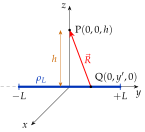
The recipe with a straight line source, , now of finite length. Every element at has a partner at , so only survives. The remaining integral is the second standard integral, taken between finite limits.
The source point is with . The displacement vector and its magnitude are
With the electric field at P is
Using for the first integral and for the second one, exactly as in Problem 3.1.1 (these are the standard integrals (3.1.30)),
The -component vanishes because every element at has a twin at . Finally,
For , and : the result of Problem 3.1.1 with . For , and : the field of a point charge . In general the finite line gives the infinite-line value multiplied by , the sine of the angle under which half of the line is seen from P.
Figure 3.1.29 shows the whole curve on logarithmic axes, where both limits appear as straight lines: slope near the line, slope far away.
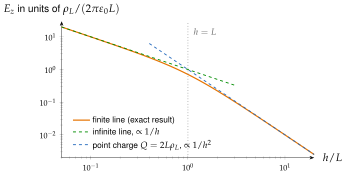
Place the field point on the perpendicular bisector of the line and vary its distance: the computed field follows close to the line and the point-charge field of far away.