Section 3.1 · Further exercises · 8 of 10
Exercise 3.1.8: Disk with a radially increasing charge
About the further exercises of Section 3.1
Ten further exercises in the spirit of Problems 3.1.1 to 3.1.3 and Home exercises 3.1.1 and 3.1.2. Every one is solved with the four steps of Section 3.1.8, and the two standard integrals (3.1.30) appear again and again.
Disk with a radially increasing charge
#cf. Problem 3.1.3
A circular disk of radius in the -plane, centred at the origin, carries the surface charge density C/m², being a constant.
a) Find the total charge on the disk.
b) Find the electric field at .
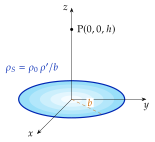
Part a) is a surface integral of over the disk with . Part b) is the surface recipe of Problem 3.1.3 with , but now the density grows with . Because does not depend on , the symmetry argument of Problem 3.1.3 is unchanged: only survives and the -integral gives . The radial integral contains in the numerator, which is not one of the standard integrals (3.1.30), so one algebraic step is needed to split it into standard forms.
On the disk the area element is (Figure 3.1.15c, and do not forget the factor ). With the charge of one element is
The integrand is a product of a function of and a constant in , so the two integrals separate:
Check of part a): is . If the density were the constant everywhere, the charge would be . Here the density equals only at the rim and is smaller inside, and the ratio of the two results is the area-weighted average of .
Rotating the disk about the -axis leaves it unchanged, because depends on only. The point P lies on this axis, so the field cannot single out a horizontal direction.
- The element at and the one at have the same density and the same distance from P. Their horizontal contributions are equal and opposite, while their -contributions are identical and add. Hence and .
- All elements on the ring of radius are at the same distance from P and carry the same density. The -integral therefore only multiplies by , and the density enters the one remaining integral, over .
The source point is on the disk and the field point is :
In polar coordinates and , so that
The charge element is , as in part a). The electric field at P is
that is, collecting the factors of and separating the components,
First the angular integrals. Since and , the - and -terms vanish, as predicted in the symmetry step, and
The numerator of is , whereas the first standard integral (3.1.30) needs there. We therefore write , which splits the integrand into two simpler terms:
The second term is times the second standard integral (3.1.30):
The first term is a new standard form. Its antiderivative is , which we check by differentiation:
Putting the two pieces together and inserting the limits,
Hence
Put . Then and , so the bracket is .
-
(far away, ): with and the bracket tends to , and
the disk looks like a point charge carrying its total charge from part a).
-
(very close to the centre): the bracket tends to , which grows only logarithmically, so and . This is reasonable: just above the centre the disk looks locally like an infinite sheet with field , and at the centre.
Units: is , and and the bracket are pure numbers, so the result is in V/m. Direction: along above a positive disk (and, by the mirror symmetry about the plane of the disk, along below it), that is, away from the disk, with no horizontal component. Far away: the point-charge field of .