Section 3.1 · Further exercises · 1 of 10
Exercise 3.1.1: Line charge of finite length, field beside it
Ten further exercises in the spirit of Problems 3.1.1 to 3.1.3 and Home exercises 3.1.1 and 3.1.2. Every one is solved with the four steps of Section 3.1.8, and the two standard integrals (3.1.30) appear again and again.
Straight line charges
Line charge of finite length, field beside it
#cf. Problem 3.1.1
A line charge of uniform density lies on the -axis from to .
a) Find the electric field at a point of the -plane, at a distance from the origin.
b) Deduce the field of a semi-infinite line charge ().
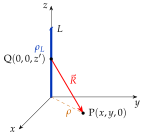
The recipe with a straight line source, , on and with P in the plane . The line now lies on one side of P only, so the -contributions have no partners below and do not cancel. We therefore keep both the radial and the -component. Each is one of the standard integrals (3.1.30).
We look at what the geometry fixes before integrating.
- Rotating the line about the -axis leaves it unchanged, so the field depends only on the distance of P from the axis (and on ), not on the angle of P.
- The plane that contains the -axis and P maps the line onto itself and P onto itself, but it reverses any component along (which is perpendicular to the plane). Therefore , and .
- In Problem 3.1.1 every element above P had a partner below P, and the -parts cancelled. Here all elements lie at , above the plane of P, and none lies below. Every element pushes P downwards (for ), so the -parts add and survives. The radial parts add as well.
Two components remain, and , and both are needed.
The source point is with , and the field point is . Then
where . The horizontal part can be written as . Here is the radial unit vector of the field point, which is fixed during the integration over .
On the straight line , so and the electric field at P is
or, separating the components,
The vector and the unit vector do not depend on , which is why they stand outside the integrals.
Both integrals are the standard ones (3.1.30), with and the constant replaced by :
The lower limit gives in the first integral but in the second one. This is the place where the one-sided line differs from the symmetric line of Problem 3.1.1, in which the second integral vanished. Inserting both results and using ,
Taking the common factor out of the braces,
For we have , so
and the result of part a) becomes
- The radial part of the semi-infinite result, , is exactly half of the result of Problem 3.1.1, since the line now extends to one side only.
- The -component is no longer cancelled by a twin element. For the semi-infinite line it equals in magnitude the radial one, so the field makes with the -plane and points away from the line, downwards and outwards.
- For a finite line the ratio of the two parts is . With , where is the angle under which the line is seen from P, this is . The field therefore points along the bisector of the angle under which the line is seen, and for () it points at .
Units: is , and the brackets are pure numbers. Direction: away from the positive line, as for every element. Far field : and is much smaller still, so
the field of a point charge carrying the total charge.