Section 3.1 · Home exercises · 3 of 4
Home exercise 3.1.3: Cathode-ray tube
Cathode-ray tube
#cf. Application 3.1.4
The electrostatic deflection system of a cathode-ray oscilloscope is depicted below. Electrons from a heated cathode are given an initial velocity by a positively charged anode. The electrons enter at into a region of deflection plates where a uniform electric field is maintained over a width . Ignoring gravitational effects, find the vertical deflection of the electrons on the fluorescent screen at .
Source: D. K. Cheng, Field and Wave Electromagnetics, 2nd ed., Example 3-3.
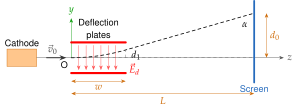
This is mechanics with the Coulomb force : a constant force between the plates (uniformly accelerated motion, as in projectile motion), no force beyond them (straight-line motion). We solve Newton's law in the two regions and join the solutions where the electron leaves the plates.
The electric field between the plates is . The charge of the electron is , so by Coulomb's law, , the force acting on the electron inside the plate system is
where is the electron mass. Solving for the vertical velocity,
The electron has no initial vertical velocity, so
Integrating once more, , and since the electron is at at ,
There is no force along , so the electron keeps its axial velocity . Eliminating shows that the path inside the plates is the parabola . Denoting by the time the electron spends inside the plates,
so the vertical position and the vertical velocity of the electron when it leaves the plates are
Beyond the plates there is no field and the electron moves on a straight line. Denoting by the time it takes to travel from the plates to the screen,
so the additional vertical displacement it gains is
The total vertical deflection of the electron on the screen is
The exit angle satisfies , so : seen from the screen, the electron appears to come from the middle of the plates. The deflection is proportional to , i.e. to the plate voltage, which is why the screen can be used as a voltmeter. With the distance measured from the end of the plates the result reads
the form used in Application 3.1.4 and in Worked example 3.1.3.
Units: is an acceleration [m/s²] and is [s²], so is in metres. Limits: gives no deflection, (no plates) gives none either, and a faster electron (larger ) spends less time between the plates and is deflected less, as .
Change the plate voltage, the plate length and the accelerating voltage: the spot on the screen moves in proportion to the plate voltage and falls back as when the electrons are made faster.