Section 3.1 · Further exercises · 3 of 10
Exercise 3.1.3: Two parallel line charges: the two-wire line
About the further exercises of Section 3.1
Ten further exercises in the spirit of Problems 3.1.1 to 3.1.3 and Home exercises 3.1.1 and 3.1.2. Every one is solved with the four steps of Section 3.1.8, and the two standard integrals (3.1.30) appear again and again.
Two parallel line charges: the two-wire line
#cf. Problem 3.1.1
Two infinitely long line charges, and , run parallel to the -axis through the points and , respectively. Find the electric field at a point of the plane midway between them.
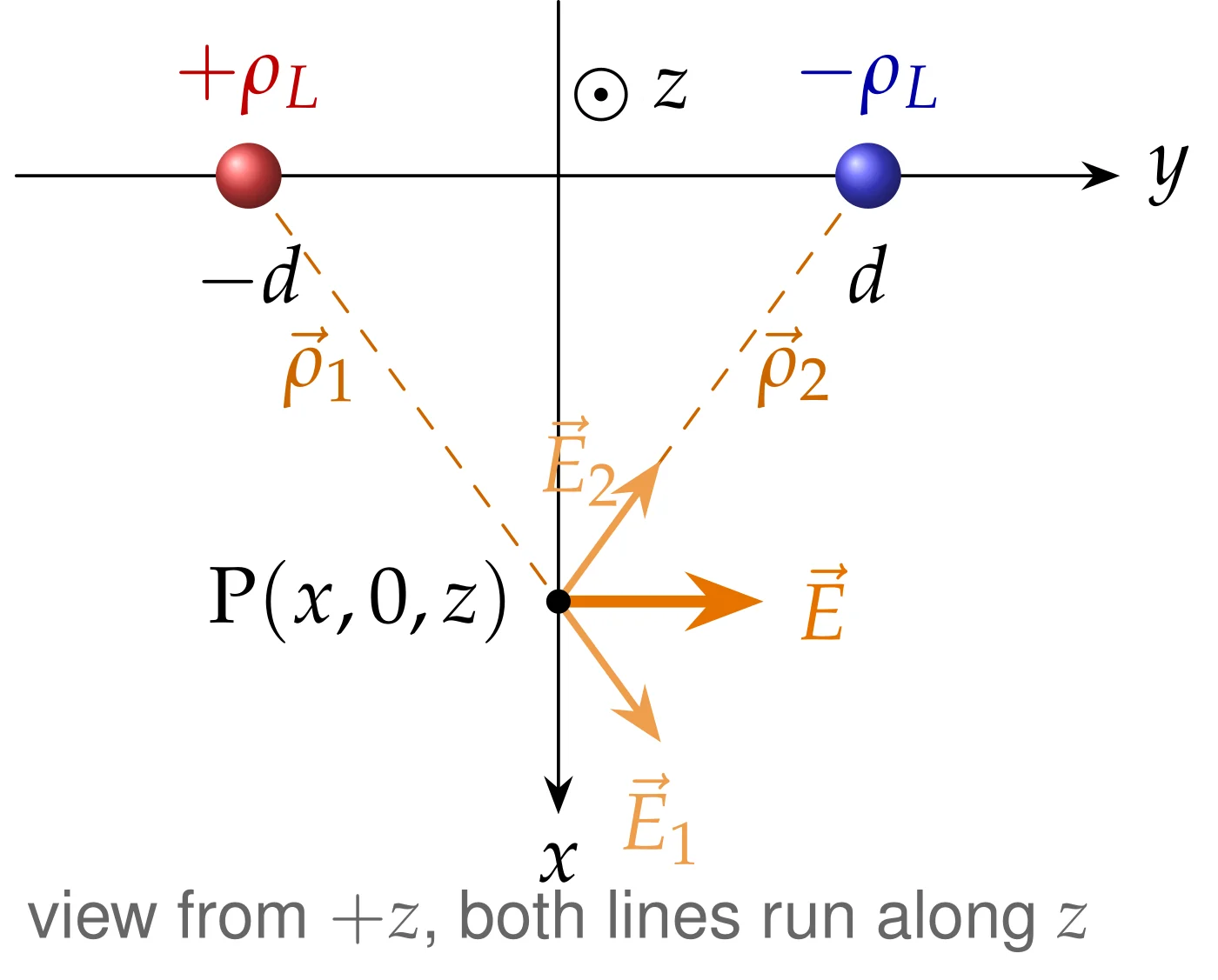
No new integral is needed: superpose two copies of the infinite-line result of Problem 3.1.1, written with the perpendicular vector from each line to P.
By the superposition principle the field is the sum of two fields of the type found in Problem 3.1.1. That result can be written with the perpendicular vector from the line to P as
From the line through and from the line through to P the perpendicular vectors are
Therefore
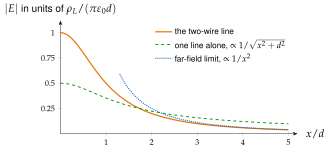
The -components cancel and the -components add: on the mid-plane points from the positive line towards the negative one, and it does not depend on . Its largest value, , is between the wires (). Far away () it falls as rather than , because the net charge per unit length is zero. This is the same reason the dipole field of Home exercise 3.1.4 falls faster than that of a point charge.