Section 3.1 · Worked examples · 1 of 4
Worked example 3.1.1: Corona wire of an electrostatic precipitator
Four short numerical calculations, covering four of the applications of Section 3.1.4. Each one starts from Coulomb's law and . Worked example 3.1.1 uses the line-charge result of Problem 3.1.1 directly, and Worked example 3.1.4 additionally borrows and from circuit theory. The best way to use them is to write down the given quantities, derive the formula yourself, and only then put the numbers in. Numerical constants used throughout (with as in Eq. (1.4.2) of Chapter 1):
Corona wire of an electrostatic precipitator
#cf. Problem 3.1.1
Given. A precipitator discharge wire of radius runs along the axis of a duct whose grounded wall is at . The wire carries a uniform line charge density .
Find. (a) the field at the wire surface and at the wall, and (b) the radius at which the field has fallen to the breakdown field of uniform air, .
The wire is long compared with the duct radius, so near the middle of the duct it can be treated as the infinitely long line charge of Problem 3.1.1. Only the line charge itself is needed: the charge induced on a coaxial (tubular) grounded wall is spread uniformly over it and produces no field inside the tube (Problem 3.2.2 in Section 3.2). Ionised gas (space charge) is ignored here.
From Problem 3.1.1, the field at a distance from the wire is radial with magnitude
At the wire surface, :
Because , the field at the wall is smaller by exactly the ratio :
Setting and solving for ,
for every radius, as the law requires: .
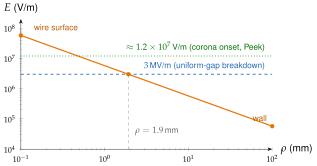
Across the gap the field changes by three orders of magnitude. Only a thin shell around the wire, about thick with uniform-air breakdown as the criterion, is stressed enough to ionise the gas, and this is the corona. Outside it the gas is merely a drift region in which the charged dust moves to the wall. A thin wire is chosen precisely to obtain this separation, and it all follows from the law. For a thin wire the true onset field is higher than (Peek's empirical law gives about for a wire in air), so the ionised shell is thinner still. Obtaining from the applied voltage requires the potential (Section 3.3), and once the corona runs its own ion cloud lowers the surface field. Both are beyond this simple space-charge-free model.