Section 3.1 · Problems · 2 of 3
Problem 3.1.2: Circular loop source
Circular loop source
#Determine the electric field at a distance above the centre of a circular loop of radius that carries a uniform charge density .
Source: B. M. Notaroš, Electromagnetics, Example 1.6.
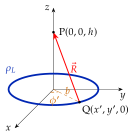
A line source again, now bent into a circle, so the element is . On the axis every element is at the same distance from P and has a diametrically opposite partner, so the horizontal parts cancel and the integral over becomes trivial.
The loop is not symmetric enough to fix the field everywhere, but it is symmetric enough on the axis, and that is where the question is asked (Figure 3.1.25).
- Rotating the loop about the -axis leaves it, and the point P, unchanged, so the field on the axis cannot single out any horizontal direction: it must be along .
- Equivalently, the element at and the one at give equal and opposite horizontal parts, while their -parts are identical and add.
- Every element is at the same distance from P and its contribution makes the same angle with the axis, . The integral over the loop will therefore simply multiply by the circumference .
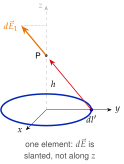
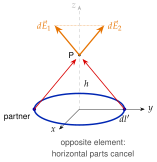
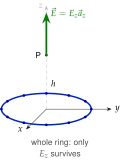
The source point is on the loop and the field point is :
From the geometry of the problem , , so that
On the circle of radius the arc element is (Figure 3.1.15b), so and the electric field at P is
Since the denominator does not depend on , it comes out of the integral, and the Cartesian unit vectors (which are constant) come out too:
The first two integrals vanish (a full period of a cosine and of a sine) and the last one equals . Finally,
The result can be rewritten in a very transparent way. With the total charge and the slant distance ,
the field on the axis is exactly the point-charge field of the whole ring at the slant distance, projected on the axis. Let us look at the limits (Figure 3.1.26).
-
: . At the centre every contribution is horizontal, and opposite elements cancel in pairs.
-
: and : far away the ring looks like a point charge carrying its total charge.
-
Since vanishes at and decays to zero as , it has a maximum in between. Setting the derivative to zero,
where .
Units: is . Direction: along above a positive ring, and (replacing by ) along below it, i.e. always away from the ring. Far away: the point-charge field of .
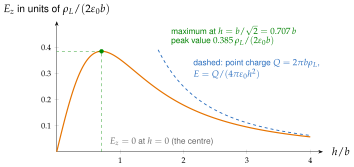
Move along the axis of the ring and find the maximum of at , then compare the curve with the point-charge field far away.