Section 3.1 · Topic 7 of 10
3.1.7 Field lines
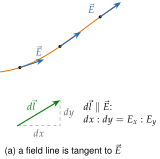
A vector field is hard to draw: at every point there is an arrow, and an arrow map such as Figure 3.1.18 quickly becomes crowded. Faraday's idea of lines of force gives a much clearer picture. For an electric field we can always find a family of curves such that the tangent of the curve passing through is parallel to the field vector at that point (Figure 3.1.19a). This family of curves is called the field lines of the electrostatic field. Think of the field lines as the "grain" of space: at every point they show the direction in which a positive charge would be pushed.
The equations of the field lines
To find the lines, let be a small step along a field line. Being tangent to the line, it must be parallel to , i.e. for some scalar (equivalently ). Writing this component by component, , , , and eliminating , the field lines are the solutions of the differential equations
In cylindrical coordinates the step is , and the same reasoning gives .
Example: a point charge at the origin
Here , and the common factor cancels in (3.1.24):
The field lines are straight lines through the charge, i.e. radial lines, pointing outwards for a positive charge and inwards for a negative one (Figure 3.1.20).


General properties
Field lines have a few general properties that we shall use again and again.
- They start on positive charges and end on negative charges (or go to, or come from, infinity). In a charge-free region they neither start nor end.
- They never cross where : at a crossing point the field would have two directions at once. Lines can only meet at points where , or at the point charges themselves, where the field is not defined.
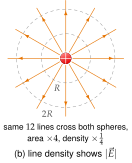
- Their density indicates the strength of the field: where the lines crowd together the field is strong, where they spread apart it is weak. Around a point charge, for example, the lines spread over spheres of area , mirroring the law (Figure 3.1.19b). This idea is made exact by the notion of flux in Section 3.2.
- A field line is not the trajectory of a charged particle in general: the force fixes the particle's acceleration, not its velocity. Only very light particles in a viscous medium (powder in air, Application 3.1.2) move approximately along the field lines.
Field lines are the paths you would trace by always stepping in the direction of . They come out of positive charges, go into negative charges, never cross, and are crowded where the field is strong.
Switch between the presets and drag the charges: the lines always leave charges, end on charges or run off to infinity, and never cross.
A charge released at rest starts to move along the field line through its starting point, but once it has a velocity it generally leaves the line (think of the curved beam between the deflection plates of Application 3.1.4, which crosses straight field lines). Field lines show the direction of the force, not of the motion.