Section 3.1 · Further exercises · 10 of 10
Exercise 3.1.10: Quarter annulus with a nonuniform charge
About the further exercises of Section 3.1
Ten further exercises in the spirit of Problems 3.1.1 to 3.1.3 and Home exercises 3.1.1 and 3.1.2. Every one is solved with the four steps of Section 3.1.8, and the two standard integrals (3.1.30) appear again and again.
Quarter annulus with a nonuniform charge
#cf. Home exercise 3.1.2
The annular arc of Home exercise 3.1.2,
now carries the surface charge density
being a constant.
a) Find the total charge on the annular arc.
b) Find the electric field at .
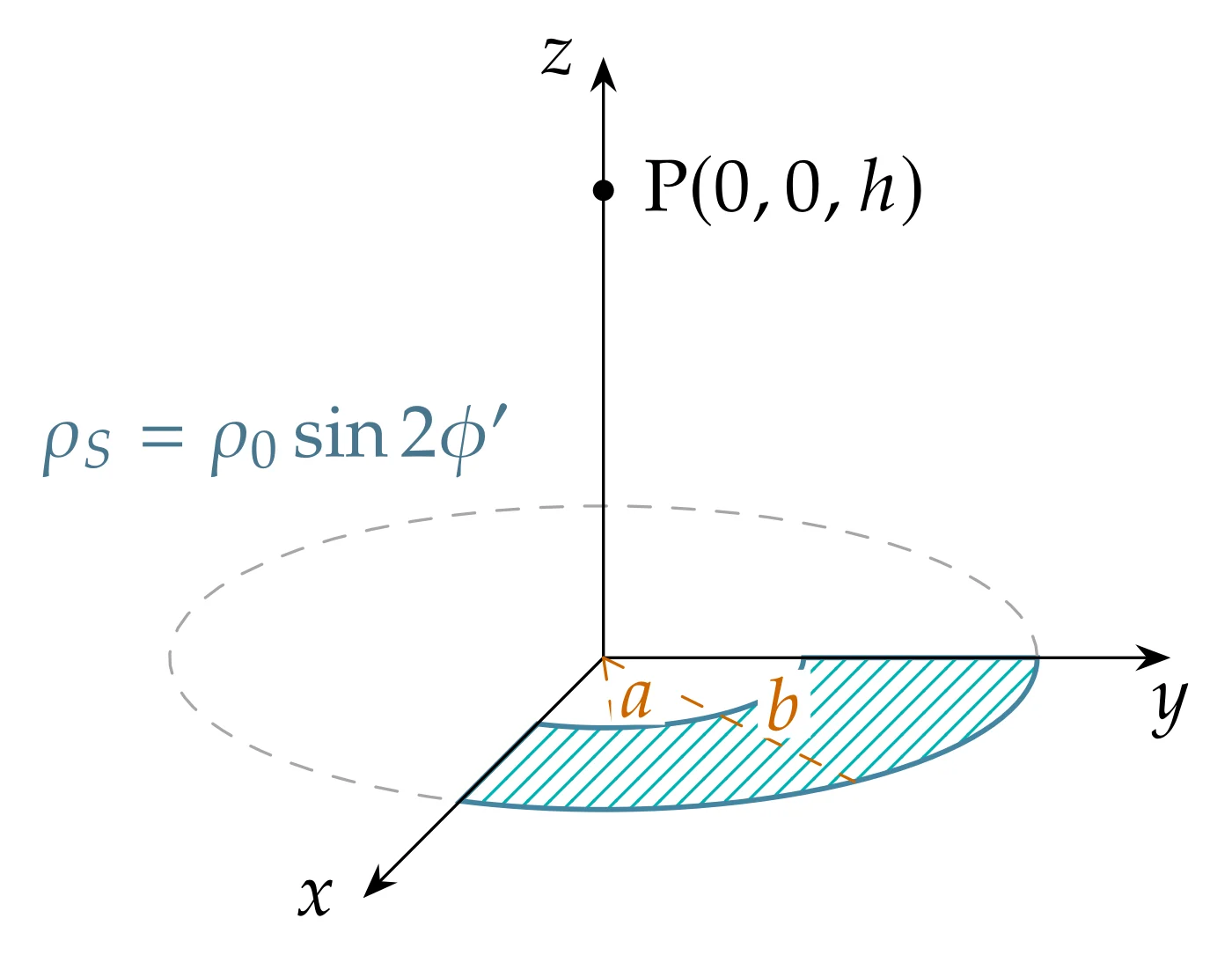
Part a) is a surface integral of over the quarter annulus with . Part b) is the surface recipe of Problem 3.1.3 with and the limits of Home exercise 3.1.2. A mirror symmetry about the plane shows that , so only two components have to be computed. With each angular integral is a power of or times its derivative, and the radial integrals are the standard integrals (3.1.30) (the second one after a split of the numerator).
On the quarter annulus (Figure 3.1.15c), so
The radial and angular integrals separate:
Check of part a): is , and because for .
The quarter annulus is not symmetric about the -axis, so the field at P has horizontal parts. One symmetry survives.
- The mirror in the plane exchanges and , that is, . It maps the quarter annulus onto itself, and it leaves the density unchanged because . The point P lies on the -axis and therefore in this mirror plane. The element at and its partner at carry the same charge, and the -component of the first contribution equals the -component of the second one. Summing over all pairs gives .
- All the charge lies in and , so nothing cancels the horizontal parts: they point away from the charge, that is, towards and , and .
- The -components of all (positive) elements point along and add up.
Hence .
The source point is on the annular arc and the field point is :
With and (now and ),
With the electric field at P is
that is, separating the components,
First the angular integrals, using :
The first two are equal, which confirms . Then
where
The integral is the first standard integral (3.1.30):
For we write , which splits the integrand into and . The second piece is times the second standard integral (3.1.30), which gives . The first piece has the antiderivative , because
Therefore, between the limits and ,
The prefactor of the horizontal part is , and that of the -part is . Finally,
-
(a full quarter disk): since and , the bracket of the horizontal part becomes , the function met in Exercise 3.1.8.
-
(far away): and , so that
The -component is the point-charge field of the total charge of part a). The horizontal components decay faster, as . They are controlled by the first moment of the charge: for the -part of is and , so . With
this gives , in agreement.
Units: is . The bracket of the horizontal part is a pure number (the argument of the logarithm and are ratios of lengths), and in the -part is a pure number as well, so every term is in V/m. Direction: by the mirror symmetry about (compare Home exercise 3.1.2, where favoured the -axis and gave ), both are negative because the positive charge lies in the first quadrant, and . Far away: the point-charge field of .