Section 3.1 · Further exercises · 4 of 10
Exercise 3.1.4: Square loop
About the further exercises of Section 3.1
Ten further exercises in the spirit of Problems 3.1.1 to 3.1.3 and Home exercises 3.1.1 and 3.1.2. Every one is solved with the four steps of Section 3.1.8, and the two standard integrals (3.1.30) appear again and again.
Square loop
#cf. Home exercise 3.1.1
A square loop of side lies in the -plane, centred at the origin, with its sides parallel to the - and -axes. It carries a uniform line charge density . Find the electric field at .
Adapted from: B. M. Notaroš, Electromagnetics, Problem 1.21.
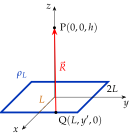
Superposition of building blocks: the loop consists of four straight sides, and each side is a finite line seen from a point above its perpendicular bisector, as in Home exercise 3.1.1. We use the symmetry of the square first, to see that only survives. Then we integrate one side with the recipe, obtain the other three by rotating through , and add.
The square is symmetric enough on the axis to settle the direction of the field (see also the ring of Problem 3.1.2).
- Rotating the square through about the -axis maps it onto itself and leaves P unchanged, so the field at P must be unchanged too. A horizontal vector that is unchanged by a rotation through must be zero, so the horizontal part of vanishes and .
- Equivalently, opposite sides give equal and opposite horizontal parts (the side at pushes P towards , the side at towards , and the same for the sides at ), while their -parts are identical and add.
- The four sides are carried into each other by the rotations, so they give the same . It is enough to compute one side and multiply by .
Take the side at . The source point is with , and the field point is . Then
where is the distance from P to the midpoint of that side.
On the straight side , so and the field of this side at P is
or, separating the components (the numbers and and the unit vectors do not depend on ),
Both integrals are the standard ones (3.1.30), with playing the role of the constant there and that of the integration variable. The second integral has an odd integrand, so it vanishes, and the first one is the integral of Home exercise 3.1.1 with replaced by :
Here . The field of the side at is therefore
The other three sides are obtained by rotating through about the -axis. They give the same expression with replaced by , and , and the same -part. The four horizontal parts cancel in pairs, exactly as Step 1 predicted, and the four -parts add:
and since ,
With the total charge (perimeter times ) the result reads
Building the square from four copies of Home exercise 3.1.1 is the same superposition idea that built the disk of Problem 3.1.3 from rings.
Units: is . Direction: along above a positive loop, away from the charge, and below it. At the field vanishes, as for the circular loop of Problem 3.1.2, because at the centre the contributions of opposite sides cancel. Far field: for the denominator behaves as and
the field of a point charge equal to the total charge of the loop.