Section 3.4 · Topic 1 of 12
3.4.1 Nonempty spaces
The phenomena we have studied in Sections 3.1 to 3.3 were all produced by known charges lying in the vacuum. We were told where the charges were, and from Coulomb's law, Gauss's law or the potential we computed the field they produce. The universe, however, is not empty. It contains bodies of very different physical properties (gases, liquids, glass, plastics, metals, the human body, the Earth itself), and every one of them is made of an enormous number of positive nuclei and negative electrons.
In an ordinary body these charges stay in balance: in every small volume there is as much positive as negative charge, and the body as a whole is electrically neutral. This balance persists as long as the body is left alone. When an external electric field is applied, however, the field pushes the positive charges one way and the negative charges the other. The charges are displaced (by a tiny distance in an insulator, freely in a metal), and the balance is broken locally: inner charges appear inside the body and on its surface.
These inner charges are charges like any other, so they too produce an electric field. The field we observe in and around a material body is therefore the sum of two contributions: the field of the charges we placed (the "external" sources) and the field of the inner charges that the body itself has formed (Figure 3.4.1).
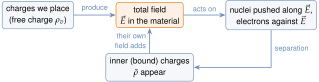
Among the sources of there are now charges that depend on itself. The field creates the inner charges, and the inner charges modify the field. This is a feedback loop that must be solved self-consistently.
Gauss's law with inner charges
Gauss's law in differential form (Section 3.2) states that the divergence of equals the total charge density at a point, whatever the origin of the charge. Let us split this total into two parts: , the density of the charges that we place and control (often called free charges), and , the density of the inner charges formed by the medium. Then
The inner charge density is not given in advance. It is a function of the electric field itself, . To make progress we need a model for this function. We define it in the form
where the dimensionless quantity (Greek "chi") is called the electric susceptibility of the medium. It measures how susceptible the material is to the field: means no response at all (vacuum), a large a strong response.
Why a divergence? Two properties make this form natural.
-
No field, no inner charges: wherever .
-
A neutral body stays neutral. Integrate Eq. (3.4.2) over a volume that contains the whole body and use the divergence theorem (Section 2.4):
because the bounding surface lies outside the body, where there is no matter and .
The total inner charge is therefore zero automatically: the field only separates charges, it cannot create them. The physical meaning of will become clear in Section 3.4.3, where we shall recognise it as the density of electric dipoles in the material.
Substituting Eq. (3.4.2) into Eq. (3.4.1) and moving the inner-charge term to the left-hand side,
that is, collecting the two divergences into one,
The inner charges have disappeared from the right-hand side: they are now hidden in the vector field on the left. This vector field deserves a name of its own.
Electric flux density and permittivity
The electric flux density (or electric displacement) is
where is the permittivity of the medium [F/m]. Writing defines the dimensionless relative permittivity (dielectric constant)
With this definition, Eq. (3.4.3) takes the compact form
This is Gauss's law in a material medium: the sources of are the free charges only, whereas the sources of are all charges, free and inner. In vacuum , , and , so everything we did in Section 3.2 is the special case of an empty medium. The unit of , coulomb per square metre, is that of a surface charge density, a fact we shall use constantly at boundaries.
is a bookkeeping device: it "counts" only the charges we put in. The material's own response is packed into one number, , which tells us by how much the material changes the relation between the field and the free charge.
The susceptibility differs from material to material. It reflects the atomic and molecular structure of the substance and, for our purposes, can only be determined experimentally. Typical values of are collected in Table 3.4.1.
A material has the susceptibility . What are its relative permittivity and its permittivity?
and F/m.