Section 3.4 · Further exercises · 3 of 10
Exercise 3.4.3: Coaxial cable with graded insulation
About the further exercises of Section 3.4
The ten exercises below are in the spirit of Problem 3.4.1, the home exercises and the worked examples. They use only , Gauss's law , the boundary conditions, the bound charges, , and the image principle.
Coaxial cable with graded insulation
#cf. the coaxial capacitor
A coaxial cable has mm and mm. The insulation consists of two layers: for mm and for . The highest permissible field in both materials is MV/m. Find (a) , (b) the field in both layers, and (c) the maximum voltage, compared with a single-layer insulation.
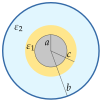
Follow the four-step capacitance recipe with per metre: Gauss's law gives the same in both layers, differs, and the voltage is the sum of the two layer integrals. For the voltage rating, find where the field is largest in each layer (at its inner radius) and set the larger of the two equal to the limit.
Gauss's law for on a coaxial cylinder of radius and length gives in both layers, so
The voltage is
The two layers act as two coaxial capacitors in series (Home exercise 3.4.1).
In each layer the field is largest at its inner radius:
The two maxima are equal: the layers are equally stressed.
With MV/m, μC/m and
With a single material throughout (either one), kV.
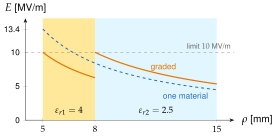
for the graded cable must lie above the single-layer value because both layers are now used at the limit (Figure 3.4.32). Indeed, .
In a single material , and only the insulation near the inner conductor works at the permitted field. Putting the higher permittivity inside lowers where is small. With both layers reach together, and the same cable carries more voltage. This is the grading of high-voltage cables and bushings.