Section 3.4 · Worked examples · 1 of 2
Worked example 3.4.1: Partly filled plate capacitor
Two short calculations tied to the applications. Each uses only , the boundary conditions, and . No new physics is needed. Try each one yourself first: write down the formula from the corresponding derivation (Problem 3.4.1, the energy of a capacitor) and only then insert the numbers.
Partly filled plate capacitor
#cf. Application 3.4.1
Given. Plates of area cm, mm apart, in air. A mica slab (), mm thick, lies on the lower plate, and kV.
Find. (a) , compared with the empty and the completely filled gap, (b) in the air and in the mica, (c) on the plates and the bound charge on the mica, and (d) the highest voltage before breakdown.
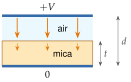
The mica face is parallel to the plates and carries no free charge, so the normal component of is continuous there: is the same in the air and in the mica, while jumps by the factor . The voltage is the sum of the two uniform-field contributions, field times thickness.
With ,
The plate charge is , hence
For comparison, pF with the gap empty and pF with the gap completely filled: half a gap of mica raises only by a factor , not .
C/m, so
Check: V.
μC/m on the plates, i.e. nC. In the mica
so the mica faces carry the bound charges μC/m (opposite in sign to the free charge on the plate side they face): five sixths of the plate charge is cancelled inside the mica.
The field in the air is six times larger, so the air breaks down first. With MV/m, MV/m and
less than the kV of the empty mm gap.
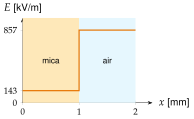
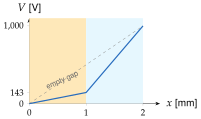
lies between the empty ( pF) and the filled ( pF) values, and the plate charge nC agrees with .
The capacitor is two capacitors in series (Home exercise 3.4.1): . The slab takes only of the voltage. The air gap takes the rest, has the higher field and breaks down first (Figure 3.4.36). A dielectric that does not fill the gap completely therefore lowers the voltage rating. The same effect makes a gas gap inside a solid insulation dangerous: by the continuity of the gas sees times the field of the solid, while it breaks down at far lower fields.