Section 3.4 · Further exercises · 9 of 10
Exercise 3.4.9: Point charge in a grounded right-angle corner
About the further exercises of Section 3.4
The ten exercises below are in the spirit of Problem 3.4.1, the home exercises and the worked examples. They use only , Gauss's law , the boundary conditions, the bound charges, , and the image principle.
Point charge in a grounded right-angle corner
#cf. the image principle
Two grounded conducting half-planes, () and (), form a right-angle corner. A point charge nC is placed at , cm. (a) Find the image charges and the potential in the region , . (b) Find the force on . (c) What is the total charge induced on the two planes?
Adapted from: D. K. Cheng, Field and Wave Electromagnetics, 2nd ed., Example 4-3.
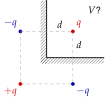
Use the image recipe plane by plane: an image in each plane, and then an image of the images, until both planes are at . All images must lie outside the corner region. The force on is the vector sum of the forces from the three images.
The image at makes the plane an equipotential, the image at does the same for . But each of these destroys the condition on the other plane, which is restored by a third image at . The four charges are antisymmetric with respect to both planes, so on and on , and in the corner region only the real charge is present. By the uniqueness theorem:
With , μN. The two images at distance attract with each, along and , and the image at distance repels with along :
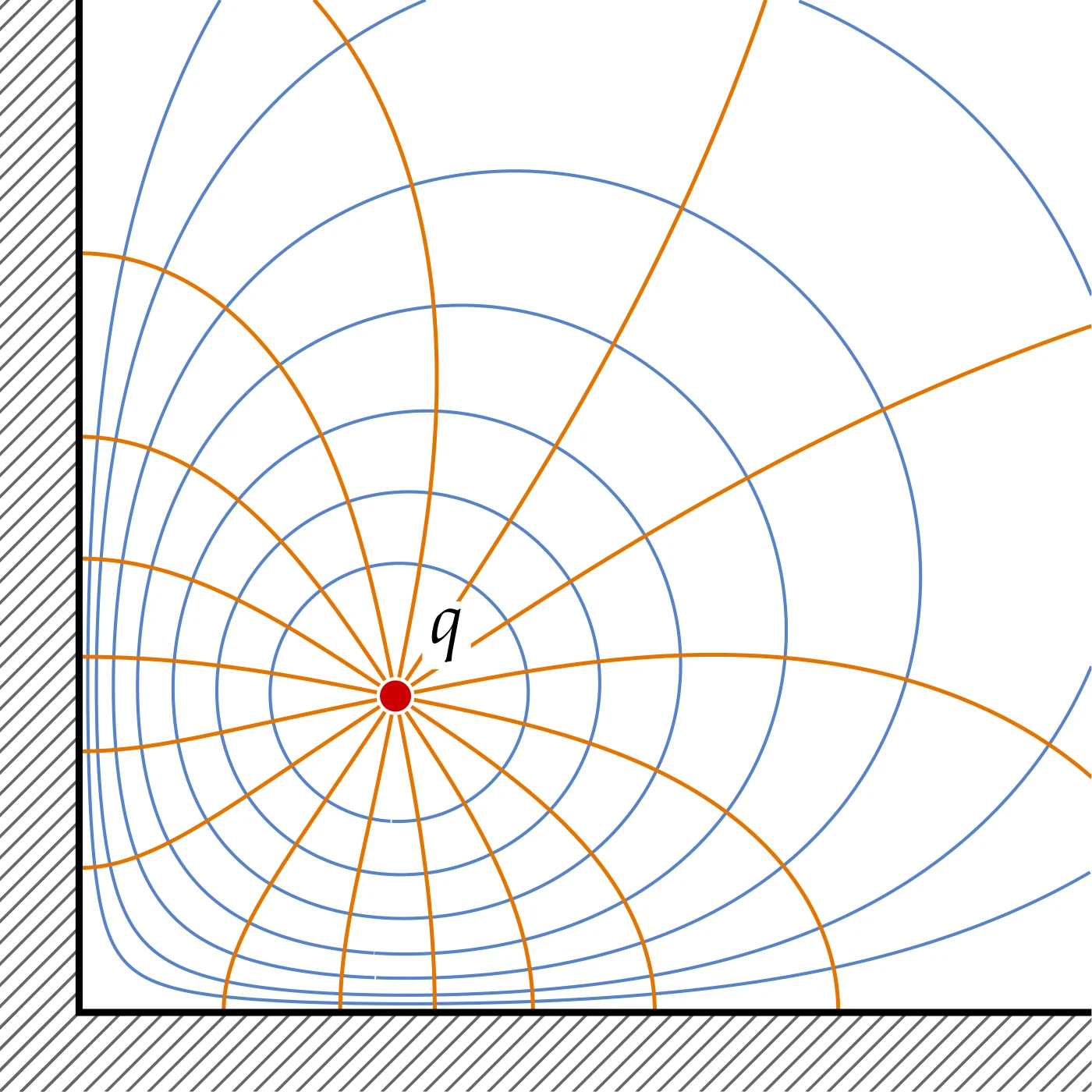
The four charges add up to zero and their dipole moment is also zero (they form a quadrupole), so far from the corner the field falls off as and no flux escapes to infinity: every field line leaving ends on the planes (Figure 3.4.34). Hence nC, shared equally by the two planes by symmetry.
If the charge were moved far from the corner along the plane (keeping its height ), the other plane would hardly matter and the force should approach that of a single plane, : indeed the images and behind the distant plane then nearly cancel each other.
The method works for a corner of angle with images ( here: three). For five images are needed, for seven. For an angle that is not of the form the images would fall inside the physical region and the method fails.