Section 3.4 · Further exercises · 10 of 10
Exercise 3.4.10: Point charge near a grounded sphere
About the further exercises of Section 3.4
The ten exercises below are in the spirit of Problem 3.4.1, the home exercises and the worked examples. They use only , Gauss's law , the boundary conditions, the bound charges, , and the image principle.
Point charge near a grounded sphere
#cf. the image principle
A grounded conducting sphere of radius is centred at the origin. A point charge is placed on the -axis at . (a) Show that an image at makes the sphere an equipotential . (b) Find the force on and the total induced charge. (c) Evaluate for cm, cm, nC, including at the nearest and farthest points of the sphere.
Adapted from: D. K. Cheng, Field and Wave Electromagnetics, 2nd ed., Example 4-5.
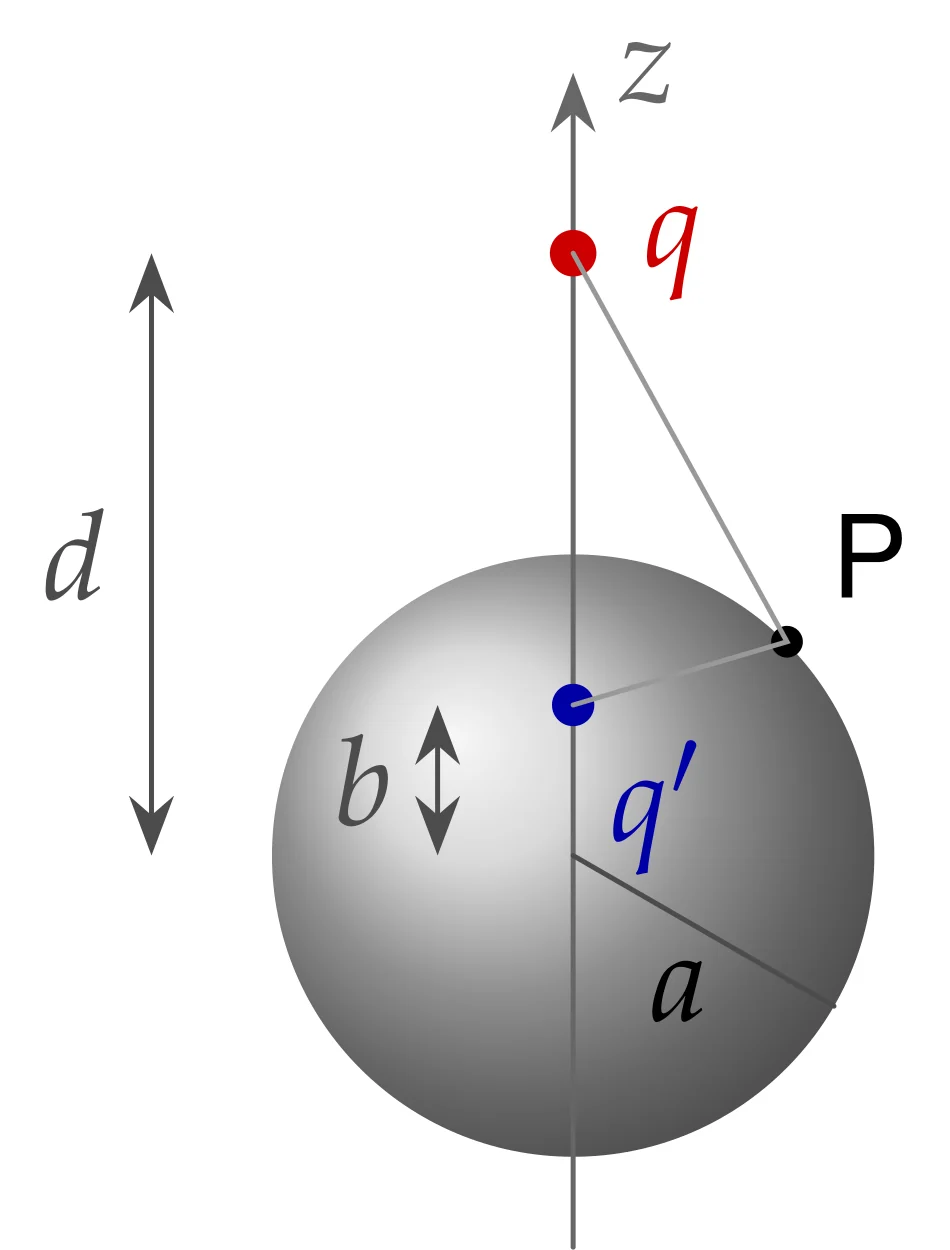
Check the proposed image directly: compute the distances from a general point P of the sphere to and to and show that the two potentials cancel. Then everything follows as for the plane: force from the image, induced charge from Gauss's law, on the surface.
Take a point P on the sphere, , at the angle from the -axis. By the law of cosines its distances to and to are given by
using . Hence and
The image lies inside the sphere, outside the region of interest, so by the uniqueness theorem the field outside the sphere is that of and .
The force is the attraction of the image, a distance away:
(negative: towards the sphere). A closed surface just outside the sphere, not enclosing , receives no net flux from and the flux from the image. By Gauss's law the charge inside it, i.e. the induced charge, is . It is smaller than in magnitude: the remaining field lines of go to infinity.
nC at cm, and cm:
The surface charge follows from at :
and nC
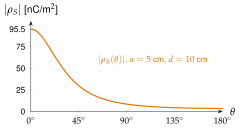
For the image charge : a very distant charge induces almost nothing on a small grounded sphere.
As the image moves to the surface and : very close to a large sphere the charge sees a plane (Section 3.4.8). For an isolated, uncharged sphere one adds a second image at the centre, so that the total charge vanishes while the surface remains an equipotential. The force is then smaller but still attractive: a neutral conductor always attracts a charge.