Section 3.4 · Topic 2 of 12
3.4.2 Field equations and constitutive relations
We now have the two fundamental equations of electrostatics in their general form,
The first equation is still true in matter. The inner charges are static charges, and the field of any static charge distribution is a Coulomb field, which we know to be conservative (Section 3.3). The second equation was derived above. Notice that neither of them contains anything specific to the medium: they hold in vacuum, in air, in glass, in a semiconductor, in a living cell. They are universal, and equations of this kind are called field equations.
The third relation, , is of a quite different nature. It says nothing universal. Instead, it describes how a particular material responds to an electric field. Different materials have different , and the same material may have a different at a different temperature, density or frequency. Relations that define the medium in this way are called constitutive relations.
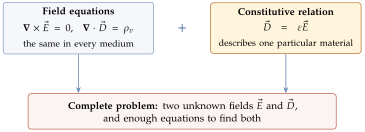
The division of labour is worth remembering (Figure 3.4.2). The field equations are two equations for two unknown vector fields and , and they are not enough by themselves. The constitutive relation closes the system by linking to . The same structure (universal field equations plus material-dependent constitutive relations) will reappear for magnetic fields and for time-varying fields.