Section 3.4 · Further exercises · 5 of 10
Exercise 3.4.5: Capacitance of an isolated sphere
About the further exercises of Section 3.4
The ten exercises below are in the spirit of Problem 3.4.1, the home exercises and the worked examples. They use only , Gauss's law , the boundary conditions, the bound charges, , and the image principle.
Capacitance of an isolated sphere
#cf. capacitance
(a) Find the capacitance of an isolated conducting sphere of radius in air, and evaluate it for cm and for the Earth ( km). (b) The cm sphere carries μC: find the stored energy from and from . (c) The sphere is coated with a dielectric layer, , . Find the new capacitance.
Adapted from: D. K. Cheng, Field and Wave Electromagnetics, 2nd ed., Problems P.3-35 and P.3-36.
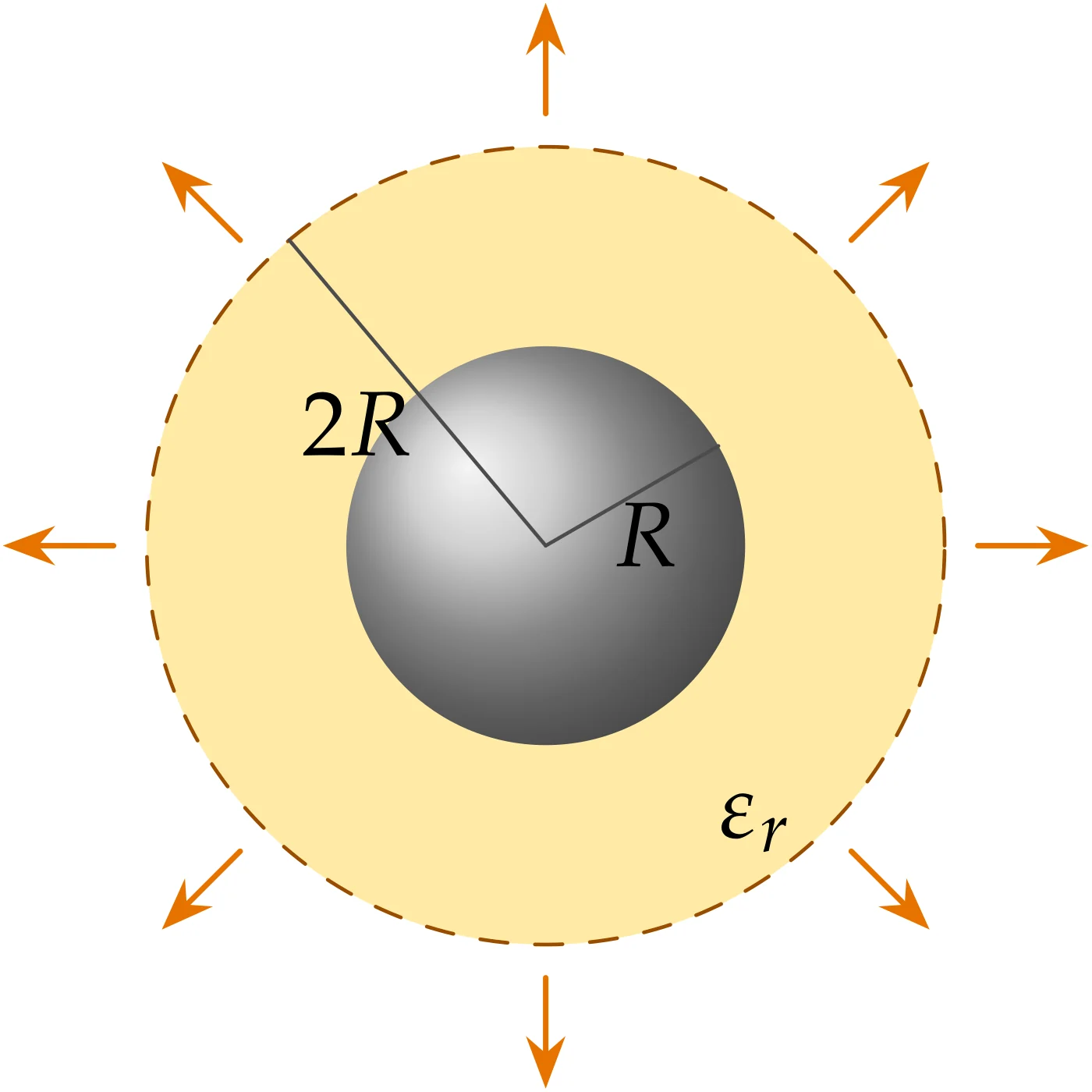
An isolated conductor is a capacitor whose second "plate" is at infinity: find of the sphere with and divide. For (b) compute the energy both ways (the recipe of Section 3.4.9), and for (c) integrate layer by layer.
A charge on the sphere spreads uniformly over its surface and produces, outside, the field of a point charge at the centre. With the potential of the sphere is , so
For cm, pF. For the Earth, μF.
kV and mJ. From the field, with :
everywhere outside the conductor. Integrating from infinity,
The coating can only raise (it lowers for the same ), and by less than the factor , because it fills only part of the field region: pF lies between and pF.
The capacitance of a conductor is a purely geometric quantity multiplied by a permittivity. It is not a property of the charge. The Earth, the largest conductor at hand, has less than a millifarad, while a single F supercapacitor has some times more. Half of the field energy of the bare sphere lies within (since , as Figure 3.4.23 shows). Filling exactly this region with divides that half of the voltage by , so drops by one third.