Section 3.4 · Topic 7 of 12
3.4.7 Conductors
The field inside a conductor is zero
In a conductor (a metal, for instance) the outer electrons of the atoms are not bound to individual atoms. They can move freely through the whole body. When an external electric field is applied to a conductor, a force acts on each of these free electrons and they start to move. They pile up on one side of the body and leave a deficit of electrons (a net positive charge) on the other side. The charges so separated produce a field of their own, which inside the conductor opposes the applied field. The motion continues as long as there is any net field left to drive it, that is, until the net force (and with it the net electric field) inside the conductor has become zero (Figure 3.4.16).
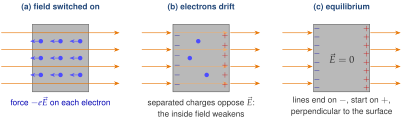
The time needed to reach this equilibrium is called the relaxation time. For good conductors it is so short that, for all electrostatic purposes, equilibrium is reached instantaneously. (A simple model gives the relaxation time as , where is the conductivity. It will be discussed with steady currents.) In electrostatics, where by definition nothing moves any more, we can therefore state:
The net electric field inside a conductor in electrostatic equilibrium is zero: .
All charge resides on the surface
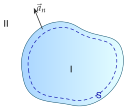
Since the field in a conductor is zero, Gauss's law lets us prove at once that all charges must reside on the surface of a conductor. Take any closed surface S lying entirely inside the metal, for example just beneath its surface (Figure 3.4.17a). On S, and therefore , so
This holds for every surface inside the metal, however small, so the charge density in the interior is zero. Any net charge placed on a conductor, and any charge induced on it by an external field, must therefore sit on its surface, in practice in a layer only a few atoms thick, which we describe as a surface charge density .
Now apply the boundary conditions of Section 3.4.6 with region I the conductor and region II the surrounding dielectric of permittivity (often air), pointing out of the conductor. In region I, and , so
Just outside a conductor the field has no tangential component: it is perpendicular to the surface. Its normal component gives the surface charge density, and vice versa: we can read the charge from the field, or the field from the charge.
A conductor is an equipotential body
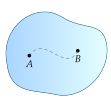
Since the net electric field in a conductor is zero, we can also prove that the potential in a conductor is constant. For any two points A and B of the conductor (Figure 3.4.17b) we choose a path from A to B lying inside the metal. Along it , so
The whole conductor, including its surface, is an equipotential volume. This is consistent with : a field perpendicular to a surface does no work along it, so the surface is an equipotential surface, and field lines meet equipotentials at right angles (Section 3.3).
What the field looks like
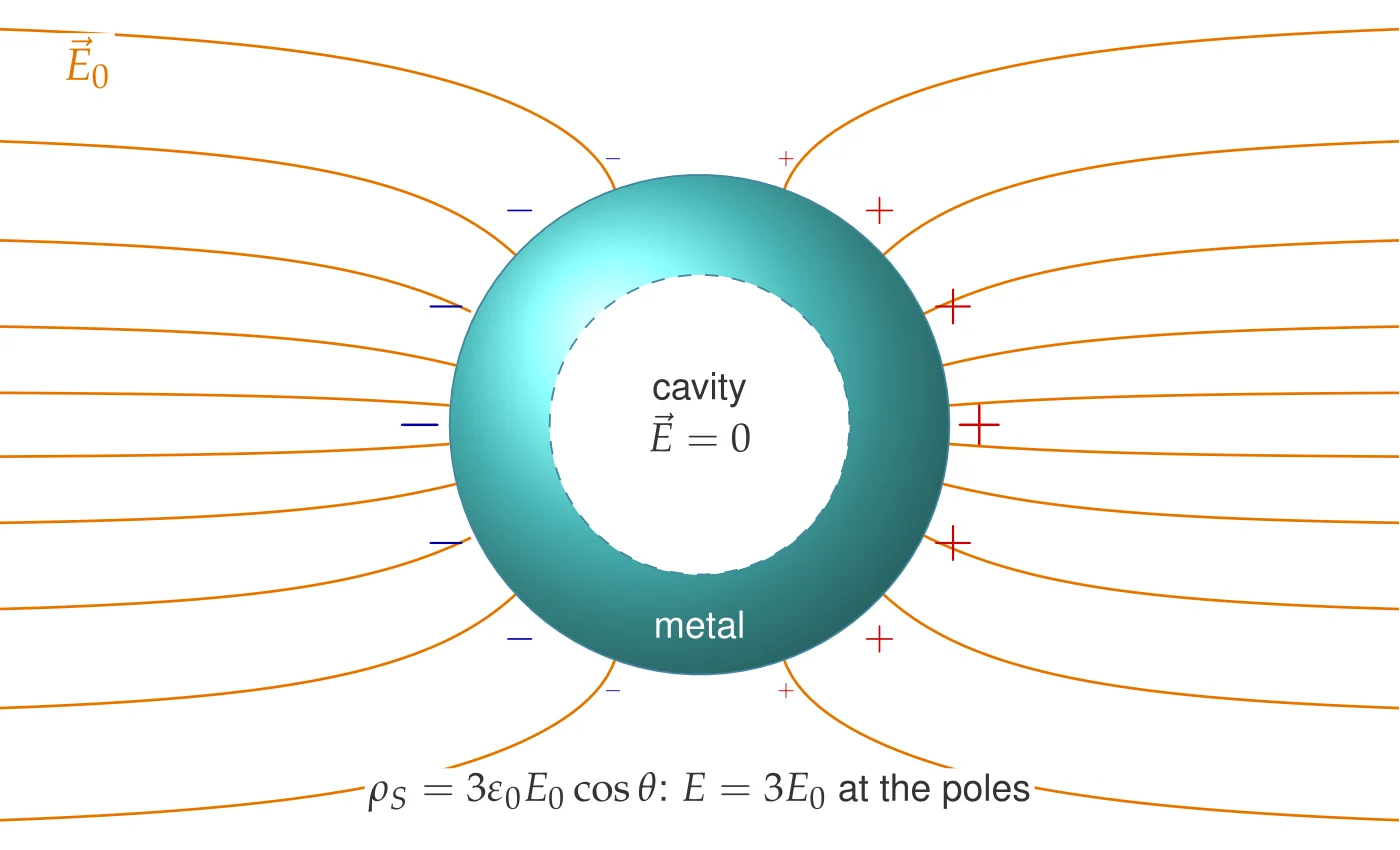
Figure 3.4.18 shows these properties at work for an uncharged hollow metal sphere placed in a uniform field (the curved version of Figure 3.4.16). Solving Laplace's equation in spherical coordinates (a technique beyond this section) gives the induced surface charge density , so that the field just outside the surface, , reaches three times the applied field at the two poles. All the properties of conductors stem from one cause:
inside every conductor in equilibrium implies, through Gauss's law and the two boundary conditions:
- Charge on the surface only: any Gaussian surface inside the metal encloses zero net charge.
- The conductor is an equipotential: for any two of its points, and just outside is normal to the surface.
- Field just outside: .
A fourth consequence is electrostatic shielding. Suppose the conductor encloses a cavity containing no charge. Could there be a field in the cavity? A field line in the cavity would have to start on the wall and end on the wall (there is no charge in the cavity for it to start or end on). Integrating along this line would give a non-zero result, because and are parallel all the way. But the integral equals the potential difference between its two end points, which both lie on the same equipotential wall, and is therefore zero. The contradiction shows that no field line can exist in the cavity: and is constant inside, whatever the field outside. This is the Faraday cage of Section 3.2.
Inside: , const. Surface: ,
A closed, uncharged metal box has an empty cavity. (a) A charge is brought near the outside of the box. Is there a field in the cavity? (b) Instead, a charge is placed inside the cavity. Is there a field in the cavity now? In the metal?
(a) No: the cavity is charge-free and bounded by an equipotential, so there. (b) Yes, in the cavity: the shielding argument assumed an empty cavity, and the field lines of the charge now end on induced charge on the cavity wall. In the metal itself , as always in equilibrium.
holds inside the metal. Just outside, the field is normal to the surface and , which is in general not zero. Nor is uniform on an arbitrary conductor: it is largest where the surface is most sharply curved or nearest to other charges (Figure 3.4.18).