Section 3.4 · Further exercises · 8 of 10
Exercise 3.4.8: Charge sharing between two capacitors
About the further exercises of Section 3.4
The ten exercises below are in the spirit of Problem 3.4.1, the home exercises and the worked examples. They use only , Gauss's law , the boundary conditions, the bound charges, , and the image principle.
Charge sharing between two capacitors
#cf. capacitance
A capacitor μF is charged to V and disconnected. It is then connected through a resistor to an uncharged capacitor μF. Find (a) the final voltage, (b) the energies before and after, and (c) the energy dissipated in , by integrating . Does the result depend on ?
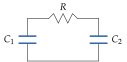
Charge is conserved, energy (in the field) is not. Find the final state from charge conservation and equal voltages, compare the energies , and confirm the loss by integrating over the transient.
The charge μC is conserved, and finally both capacitors have the same voltage (they are in parallel):
The voltage difference drives the current . With and ,
The dissipated energy does not contain : the fraction is lost however small the resistance.
Energy balance: mJ .
Charge is conserved, field energy is not: . For the loss does not vanish but goes into the spark at the contact and into radiation. The loss is fixed by the initial and final states alone, and the mechanism only decides where the energy goes.