Section 3.4 · Further exercises · 7 of 10
Exercise 3.4.7: Force between capacitor plates
About the further exercises of Section 3.4
The ten exercises below are in the spirit of Problem 3.4.1, the home exercises and the worked examples. They use only , Gauss's law , the boundary conditions, the bound charges, , and the image principle.
Force between capacitor plates
#cf. Home exercise 3.4.4
An air capacitor has plates of area a distance apart. (a) The capacitor is isolated with charge : find the force between the plates from the energy and show that it corresponds to a pressure on each plate. (b) Repeat with the voltage held fixed. (c) Evaluate for cm at MV/m, and for kV, mm.
Adapted from: D. K. Cheng, Field and Wave Electromagnetics, 2nd ed., Example 3-26.
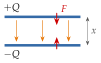
The energy method again: at constant charge the force is , while at constant voltage the source also does work and the force is . Dividing by the plate area gives the pressure.
and, at constant charge, . A virtual displacement of the upper plate costs :
an attraction independent of . With and ,
The electric pressure on a conductor equals the energy density of the field at its surface.
At constant voltage the source does work too, and the correct expression is then with :
the same force, since . But now, with fixed, it grows as when the plates approach.
At MV/m: Pa and N on cm. At kV, mm: MV/m, Pa, mN.
Units: is [F/m][V/m] [J/m] [N/m], a pressure.
In air, electric forces are weak: even at the breakdown field the pressure is only Pa ( mbar). They become important at small gaps, where the field can be much higher: MEMS switches and electrostatic micro-actuators, and the electrostatic voltmeter, which measures through this force. Note that the pressure is , not : the field at the plate is produced half by the plate's own charge, which exerts no force on itself. Only the field of the other plate acts.