Section 3.4 · Home exercises · 2 of 4
Home exercise 3.4.2: Half-filled spherical capacitor
Half-filled spherical capacitor
#A conducting sphere of radius is held at the potential . It is surrounded by a concentric, grounded conducting shell of radius . One half of the space between them is air (), the other half is filled with a dielectric of permittivity , and the plane interface passes through the centre.
- Find and between the conductors.
- Find the surface charge densities at the points A (air side) and B (dielectric side) of the inner sphere.
- Find the charge of the inner sphere and the capacitance.
Adapted from: B. M. Notaroš, Electromagnetics, Example 2.20.
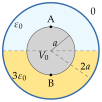
Guess that the potential is still spherically symmetric, solve Laplace's equation for , and then check the boundary conditions on the flat interface. If they hold, the uniqueness theorem makes the guess the solution. The charges then follow from , which is different in the two halves.
In each half the medium is simple and charge-free, so satisfies Laplace's equation. Both conductors are spheres centred at O and the interface is a plane through O, so we try a potential that depends on only. In spherical coordinates (Section 2.3) Laplace's equation then reads
The two conductor potentials give
This single function must also satisfy the boundary conditions on the plane interface. is radial, hence tangential to the interface, and has the same value on both sides: . The normal components of and are both zero: . All conditions are met, so by the uniqueness theorem this is the solution, in both halves.
On the inner sphere the normal out of the conductor is , and at the field is . With :
Each hemisphere has the area and a uniform charge density:
If both halves were air, with gives , and if both were the dielectric, . Our is exactly the average, as expected for two halves in parallel.
The field is the same in both halves, but and the free charge are three times larger on the dielectric side. The bound charge on the dielectric face at is , so the total charge there, , equals that on the air side, which is why is spherically symmetric. Since is tangential to the interface, the two halves are two hemispherical capacitors in parallel: a full spherical capacitor with has , and . The outer shell carries and on its two halves, in total .