Section 3.4 · Further exercises · 2 of 10
Exercise 3.4.2: Point charge inside a dielectric shell
About the further exercises of Section 3.4
The ten exercises below are in the spirit of Problem 3.4.1, the home exercises and the worked examples. They use only , Gauss's law , the boundary conditions, the bound charges, , and the image principle.
Point charge inside a dielectric shell
#cf. the polarisation picture
A point charge nC sits at the centre of a spherical dielectric shell, cm cm, , and everywhere else is air. Find (a) , and in all regions, (b) the bound charges, and (c) the potential at , compared with the value without the shell.
Adapted from: D. K. Cheng, Field and Wave Electromagnetics, 2nd ed., Example 3-12.
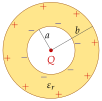
With spherical symmetry, Gauss's law for gives everywhere at once, because it sees only the free charge and does not care about the shell. Then region by region, and .
By symmetry . Gauss's law on a sphere of radius encloses only the free charge , whatever the medium:
Then and :
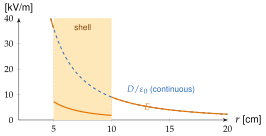
jumps from kV/m to kV/m at and from kV/m to kV/m at , while is continuous at both surfaces (Figure 3.4.31).
Inside the shell , because is constant, so . On the faces, with the outward normals at and at :
Multiplying by the areas and :
Integrating inwards from infinity:
against V without the shell.
The total bound charge is nC, as for any neutral body.
Inside the shell the field is that of the charge , i.e. screened by the bound charge on the inner face. Outside, the two bound layers cancel and the field is that of alone: a dielectric shell cannot shield a charge. The total bound charge is zero, as it must be.
Change and the radii of the shell in the tool below: ignores the shell, while drops by the factor inside it and returns to the vacuum curve outside.