Section 3.4 · Further exercises · 6 of 10
Exercise 3.4.6: Energy of a uniformly charged sphere
About the further exercises of Section 3.4
The ten exercises below are in the spirit of Problem 3.4.1, the home exercises and the worked examples. They use only , Gauss's law , the boundary conditions, the bound charges, , and the image principle.
Energy of a uniformly charged sphere
#cf. electrostatic energy
A sphere of radius in vacuum carries the charge uniformly distributed in its volume. Find its electrostatic energy (a) from and (b) from . (c) What fraction is stored inside the sphere? (d) If the rest energy of the electron were all electrostatic, how large would the electron be?
Adapted from: D. K. Cheng, Field and Wave Electromagnetics, 2nd ed., Example 3-22, Problems P.3-40 and P.3-41.
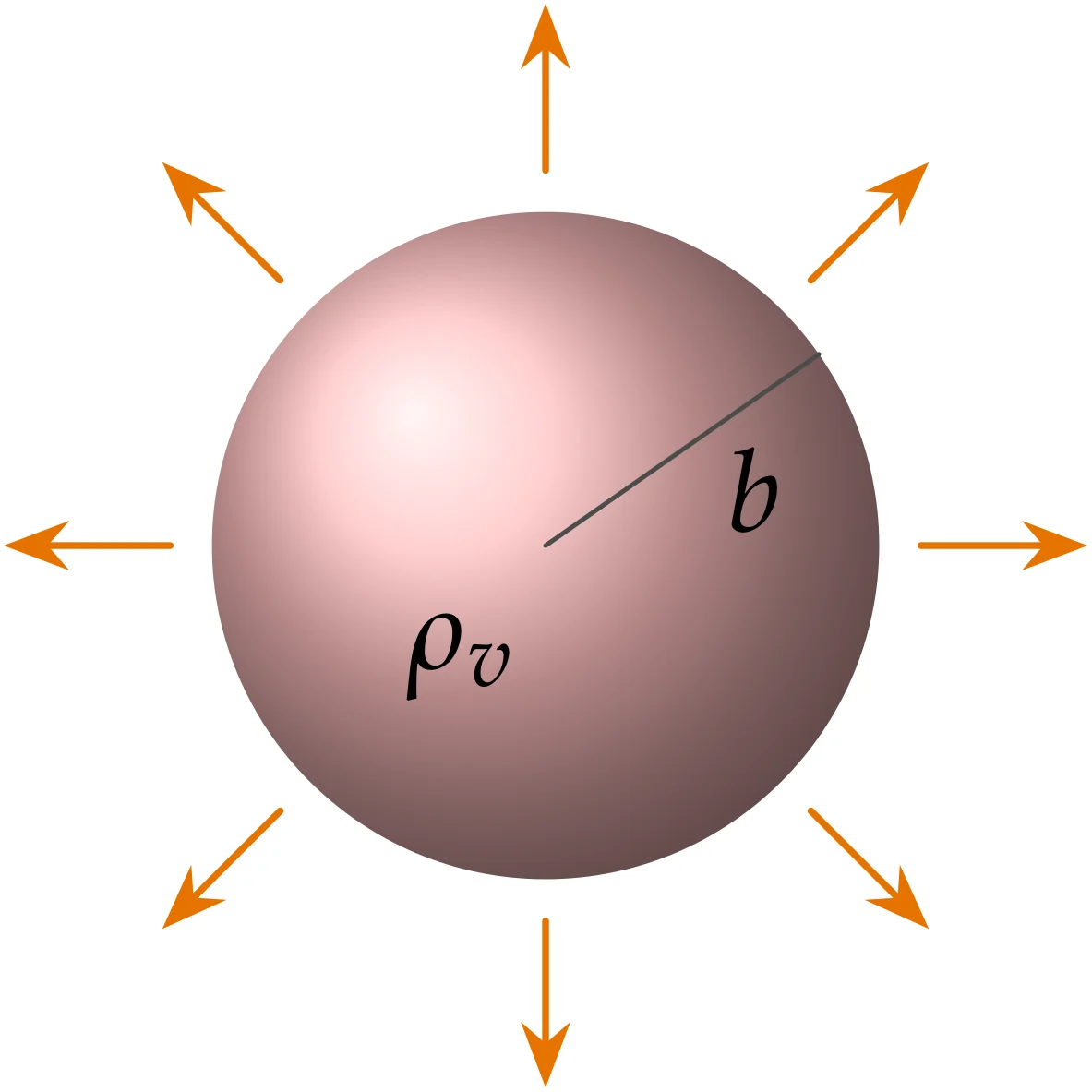
First find inside and outside with Gauss's law, then by integrating from infinity. With both at hand, evaluate the two energy integrals with and compare.
With , Gauss's law (Section 3.2) gives
and integrating from infinity, for (it equals at , as it should).
and
: five sixths of the energy is stored outside the sphere.
Setting with :
where fm is the classical electron radius.
The two formulas must agree: counts the work of assembling the charge, locates the same energy in the field. As the energy diverges: a point charge has an infinite self-energy, a classical puzzle that even quantum electrodynamics does not remove but handles by renormalisation. Experiments show the electron to be much smaller than fm. No size has been detected at all.