Section 3.4 · Home exercises · 4 of 4
Home exercise 3.4.4: Partly inserted dielectric slab
Partly inserted dielectric slab
#A parallel-plate capacitor has rectangular plates of length and width , a distance apart, and carries the charge (isolated). A dielectric slab of permittivity and thickness is pushed in to the length , and the rest of the gap is air. Neglect fringing.
- Find the capacitance .
- Find the stored energy .
- From at constant , find the force on the slab. Is the slab pulled in or pushed out?
Adapted from: D. K. Cheng, Field and Wave Electromagnetics, 2nd ed., Problem P.3-48.
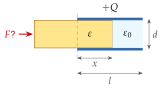
Treat the filled and the empty parts as two capacitors in parallel to get . The force is found without ever looking at the (complicated) fringing field, by the energy method: for an isolated capacitor any mechanical work must be paid for by the stored energy, .
Both regions lie between the same two plates and have the same voltage: the filled part (area ) and the empty part (area ) are two capacitors in parallel (Home exercise 3.4.1). In each part the field is uniform, , and it is tangential to the face of the slab, hence continuous there :
With the charge fixed, the most convenient form of the energy is :
The capacitor is isolated, so in a virtual displacement of the slab the mechanical work done by the electric force is taken from the stored energy: at constant . Hence
Since , : the force points in the direction of increasing and the slab is pulled into the capacitor.
For the force vanishes, as it must: nothing distinguishes the "slab" from air. Units: has C/(F·m) J/m N.
In terms of the voltage the same force is , which at constant voltage does not depend on . (At constant one must use , because the source then supplies twice the energy that is stored, half going into the field and half into mechanical work.) Physically, the force is produced by the fringing field at the edge of the plates, which pulls on the bound charges of the slab. Yet the energy method gives it correctly without our ever computing the fringing field. Dielectric liquids are drawn up between the plates of a level gauge by the same force.
Now push the slab in and out with the tool below, first with the capacitor isolated (constant ) and then connected to a source (constant ), and compare the two cases: at constant the voltage and the stored energy fall as the slab goes in, at constant the charge and the stored energy rise, yet in both cases the force pulls the slab into the capacitor.