Section 3.4 · Home exercises · 3 of 4
Home exercise 3.4.3: Two-layer spherical capacitor
Two-layer spherical capacitor
#A spherical capacitor has an inner conductor of radius at the potential and an outer conductor of radius at the potential . The region is filled with a dielectric of permittivity , the region with .
- Find and in both regions.
- Find on the outer conductor and its charge .
- Find the capacitance and the stored energy .
Hint: solve Laplace's equation in each layer. At , and are continuous.
Adapted from: D. K. Cheng, Field and Wave Electromagnetics, 2nd ed., Problem P.3-37.
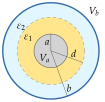
This is the "solve in each region, then glue" method. Laplace's equation gives in each layer: four constants. Two conductor potentials and two interface conditions (continuity of and of ) fix them.
Laplace's equation holds in each layer and, by spherical symmetry, :
Four conditions are needed to fix the four constants. Two are the conductor potentials,
and two are the boundary conditions at the interface , which carries no free charge: is continuous (first condition) and so is (second condition),
The last condition says that is the same function in both layers, as Gauss's law requires. Writing with in layer 1 and in layer 2,
With the shorthand ,
Then and give and :
On the inner face of the outer conductor the normal pointing out of the conductor, into the gap, is :
The inner conductor carries (check: ), and
The energy follows from integrated over the two spherical shells, with the volume element and each layer's own permittivity:
which, with and inserted, reduces to
gives and , the single-dielectric result.
two spherical capacitors in series (Home exercise 3.4.1), since the interface is an equipotential. Because , a layer of high permittivity next to the inner conductor (where is small) evens out the field. This is the principle of graded insulation in high-voltage cables (Exercise 3.4.3).
Move the interface radius and change and in the tool below: stays continuous at while jumps by the factor , and putting the higher permittivity inside evens out the field across the gap.