Section 3.4 · Home exercises · 1 of 4
Home exercise 3.4.1: Capacitors in series and in parallel
Capacitors in series and in parallel
#Capacitors are connected (a) in parallel (same voltage across each), (b) in series (same charge on each, the inner plates initially neutral). Starting from , show that the equivalent capacitances are
Then use the series result to recover the capacitance of the partly filled capacitor of Worked example 3.4.1.
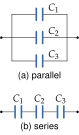
Use only the definition and two facts about the circuit: in parallel the voltage is common and the charges add, while in series the charge is common (charge conservation on the isolated inner plates) and the voltages add.
All capacitors are connected between the same two nodes, so each has the same voltage and carries the charge . The source delivers the total charge
The source moves a charge onto the first plate of and onto the last plate of . Each inner pair of plates, together with the wire joining them, is an isolated conductor that was neutral. If one of its plates takes , the other must take . Hence every capacitor carries the same charge , and . The voltages add:
The plane interface between the air and the mica is parallel to the plates and, since the field is uniform and normal to it, it is an equipotential. A thin metal foil could be inserted there without changing the field. The capacitor is then an air capacitor in series with a mica capacitor :
Two equal capacitors : parallel , series , as expected.
In parallel the capacitances add because the areas add (same , more plate), while in series the reciprocals add because the gaps add (same , longer path). is always smaller than the smallest (Figure 3.4.29).