Section 3.4 · Topic 9 of 12
3.4.9 Electrostatic energy
Charging a capacitor takes work, and the capacitor can give this work back: a camera flash, a defibrillator and the back-up supply of a memory chip all rely on it. Where is the energy kept in the meantime? We shall answer this question in two steps: first we compute the work needed to assemble a set of charges, then we rewrite the result so that the energy appears to be spread through the field. The final answer is
the integral extending over all space where the field exists. In a homogeneous medium can be taken outside the integral, . Rather than accept Eq. (3.4.24) as a definition, let us derive it from the work needed to assemble a charge distribution.
The work of assembling charges
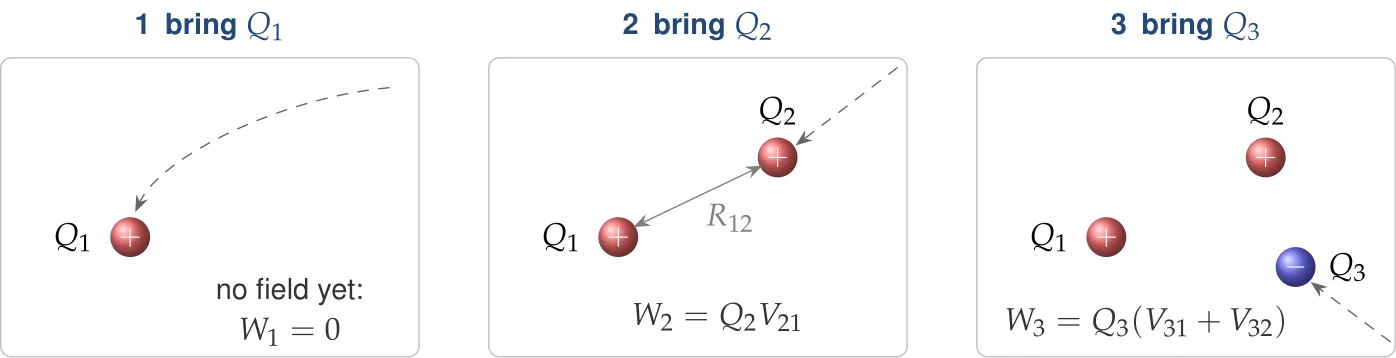
Start with an empty space and bring point charges in from infinity, one at a time, so slowly that no kinetic energy is involved (Figure 3.4.22). Bringing the first charge costs nothing, since there is no field yet. Bringing to its place costs , where is the potential of at the position of (Section 3.3: the work done against the field is charge times potential difference, and at infinity). Bringing costs , and so on. For charges
Since , each pair appears once and the sum is symmetric. Writing it as half of the sum over all ordered pairs (each pair is then counted twice, hence the ),
where is the potential at the position of due to all the other charges. For a continuous distribution the sum becomes an integral:
(In the continuous form is the potential of the whole distribution. The contribution of an infinitesimal element to the potential at its own position is negligible, which is why the restriction disappears. For true point charges the continuous form would include their infinite self-energies. See Exercise 3.4.6.)
In a dielectric we must be a little more careful, because bringing in free charge also polarises the medium, and the work done includes the energy stored in the polarisation. Let the free charge density be increased by a small amount in a medium where the potential is already . The work required is . In a linear medium all fields and potentials are proportional to the charges, so we may build up the final distribution by bringing in the same fraction of every charge, growing from 0 to 1. At the stage , the potential is and the increment of charge is , so
with the free charge density. Equation (3.4.25) therefore holds in any linear medium.
Energy in terms of the field
Now we move the energy from the charges to the field. The plan: replace by , integrate by parts with a vector identity, and show that the surface term vanishes at infinity. Using :
The volume may be taken as a sphere of radius so large that it contains all the charges. By the divergence theorem the first integral becomes . Far from the charges falls off at least as and at least as , while the area grows as . The surface integral falls off at least as and vanishes as . In the second integral . Hence, integrating over all space,
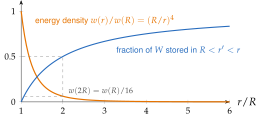
The two expressions (3.4.25) and (3.4.26) give the same total energy but describe it differently: counts the work of assembling the charges, while locates the same energy in the field, with the energy density at each point. The field picture is the one that survives in electrodynamics, where fields carry energy away from their sources. Exercise 3.4.6 compares the two for a uniformly charged sphere.
Wherever there is an electric field there is stored energy, joules in every cubic metre. Strong fields store a lot (the energy grows with the square of ), so most of the energy sits where the field is strongest.
Energy of a charged capacitor
For a system of conductors, each conductor is an equipotential carrying the surface charge , and Eq. (3.4.25) becomes . For two conductors carrying and at the potentials and ,
With the capacitance defined in Section 3.4.10, this is .
- From the circuit quantities: find and (or ) and use . For a charge distribution use .
- From the field: find (and ) everywhere, write with the local , choose the volume element of the symmetry (, , ) and integrate region by region.
- Compare: the two results must agree. If they do not, look for a forgotten region (the field outside a charged sphere), a wrong in one layer, or a missing factor .
The stored energy is , not . The source that charges a capacitor to the voltage does deliver , but half of it is dissipated in the resistance of the charging circuit (or radiated), whatever that resistance is (compare Exercise 3.4.8). The factor comes from the charge being brought in against a potential that grows from to .
A capacitor connected to a source has its voltage doubled. By what factor does the stored energy change? And the energy density between the plates?
Both grow by : and with .
In a capacitor the field fills only the dielectric between the plates, so by Eq. (3.4.26) the stored energy is , and in terms of circuit quantities it is by Eq. (3.4.27). There are two quite different routes to a large stored energy.
High field, ordinary capacitance: the film capacitor
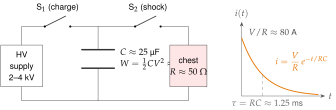
A defibrillator (Figure 3.4.24) charges a capacitor slowly and discharges it into the patient's chest in milliseconds. External shocks are of the order of – J. With voltages in the kilovolt range, keeps the capacitance at tens of microfarads: J at kV requires μF. Polypropylene film operated at MV/m stores
so the 200 J need about half a litre of film, wound into a roll (Worked example 3.4.2). With the chest resistance , the time constant is ms and the peak current A: the energy is delivered in a few milliseconds.
Low voltage, enormous capacitance: the supercapacitor
In an electrochemical double-layer capacitor (supercapacitor) the "plates" are a porous carbon electrode and a layer of ions of the electrolyte that gathers about nm from its surface. Porous carbon has a surface area of the order of m per gram, so reaches the order of F per gram of electrode, and cells of F are common. The electrolyte decomposes above roughly V, which limits the energy to kJ Wh per cell. This is a few watt-hours per kilogram, far below the – Wh/kg of lithium-ion batteries, but a supercapacitor survives – charge cycles and delivers kilowatt pulses.
The two devices illustrate one rule: the energy density is set by the field the dielectric can bear. The supercapacitor stores some fifty times more energy than the defibrillator capacitor, but at V it could drive only mA through the chest. For a defibrillator, what counts is the voltage.
, the energy density is limited by