Section 3.4 · Problems · 1 of 1
Problem 3.4.1: The dielectric-filled parallel-plate capacitor
The dielectric-filled parallel-plate capacitor
#Let the potentials of the conducting planes and be and , respectively. Assuming that the region between these planes is filled with a simple dielectric material of permittivity and does not involve any charge, find the explicit expression of the potential function in this region. Find an expression of in terms of and , where stands for the charge in an area on the plane .
Adapted from: D. K. Cheng, Field and Wave Electromagnetics, 2nd ed., Example 4-1.
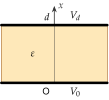
The voltages of the plates are given, not their charges, so we solve Laplace's equation with the two plate potentials as boundary conditions (the second route of the capacitance recipe). The charge then follows from the conductor condition , and .
There is no free charge between the plates, so . The medium is simple, so with constant , and
The planes are infinite in the - and -directions, so by symmetry depends on only and Laplace's equation reduces to an ordinary differential equation,
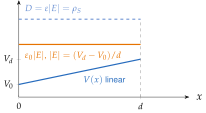
The two plate potentials, and , give and . Hence
The electric field and the flux density are uniform:
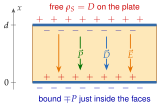
On the lower face of this plate the normal pointing out of the conductor, into the dielectric, is . The conductor condition gives
and therefore
(The plate carries , as there.)
The polarisation is
It is uniform, so . On the upper face of the dielectric, which touches the plate and has the outward normal ,
and the opposite value appears on the lower face. The total charge at is : exactly the charge that would produce the same field in vacuum, as it must be, since sees all charges (Figure 3.4.30).
The field fills the volume with the energy density , so
Units: has [F/m]·[m]/[m] [F]. With we recover the empty capacitor .
and are exactly the same as for the empty capacitor (Problem 3.3.1), because the plate voltages are prescribed and Laplace's equation does not contain . What the dielectric changes is , and with it the free charge that the source must supply: times more, hence with . The bound charge cancels part of the free charge: .
Voltage fixed (capacitor connected to a source): is unchanged, while , and grow by the factor . Charge fixed (isolated capacitor): is unchanged, while , and fall by the factor .
Solve the capacitor numerically in the tool below: with the gap completely filled the potential stays linear and grows by , while a dielectric that fills only part of the gap makes the field jump at its face and acts like two capacitors in series (Worked example 3.4.1).