Section 3.4 · Further exercises · 1 of 10
Exercise 3.4.1: Refraction of \vec E at a dielectric interface
The ten exercises below are in the spirit of Problem 3.4.1, the home exercises and the worked examples. They use only , Gauss's law , the boundary conditions, the bound charges, , and the image principle.
Refraction of at a dielectric interface
#cf. boundary conditions
The plane separates two simple dielectrics: for and for . There is no free charge on the interface. In region 1, just below the interface,
Find (a) and just above it, (b) the angles , that , make with the normal, and (c) the bound surface charge density on the interface.
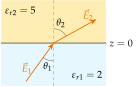
Apply the recipe for boundary conditions: the normal is , so copy the tangential components ( and ), and obtain the normal component from the continuity of . The bound charge follows from on both sides.
The tangential components of are continuous:
With the normal component of is continuous:
Check: pC/m
The tangential part has the magnitude on both sides:
in agreement with Eq. (3.4.18).
, so and . On the interface the outward normal of dielectric 1 is , that of dielectric 2 is , and the two bound layers add up to
The field enters the medium of higher permittivity and bends away from the normal (), as in Figure 3.4.14.
In vacuum terms the interface carries the total charge , all of it bound and none free. Entering the medium of higher permittivity the field line bends away from the normal. A light ray entering an optically denser medium does the opposite and bends towards the normal. The two phenomena obey different laws.