Section 4.1 · Topic 1 of 11
4.1.1 The Lorentz force
What the experiments show
Coulomb's law of Section 3.1 tells us the force on a charge that stands still in the field of some source: . Now let the test charge move, with velocity , near a magnet or near a wire that carries a current. Experiments show three things:
- the force on the moving charge is different from ,
- the difference is proportional to the speed of the charge (a charge at rest feels only , and doubling doubles the extra force), and
- the difference is perpendicular to the velocity , whatever the direction of .
A force that is always perpendicular to the velocity and proportional to it has the form of a vector product with some fixed vector. This observation is turned into the basic assumption of magnetism.
Let the force acting on a point charge which moves in an electric field with a certain velocity be . Then the difference is both perpendicular to and linearly dependent on the product . The vector that expresses this linear dependence is called the magnetic induction or magnetic flux density :
The unit of is the tesla, (the weber, Wb, is the unit of magnetic flux, Section 4.1.6). The Earth's field at the surface is to μT, a strong permanent magnet gives a few tenths of a tesla at its surface, and the magnet of a hospital MRI scanner to T. The older unit gauss is T.
Figure 4.1.1 shows the magnetic part of the force. A positive charge moving to the right through a field pointing into the page is pushed upward, at right angles both to and to . The three vectors , , form a right-handed triad: point the fingers of the right hand along , curl them towards , and the thumb gives . For a negative charge the force is reversed. The magnitude is
where is the angle between and : largest when the charge moves across the field, zero when it moves along it.
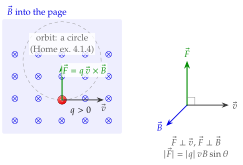
Drag the velocity arrow or change : the charge runs on a circle whose radius grows with , while the period stays the same.
An electric field pushes a charge along the field, whether the charge moves or not. A magnetic field pushes a charge sideways, at right angles to its motion, and only while it moves. The faster the charge, the harder the sideways push.
Because is perpendicular to , the power it delivers is . A magnetic field can bend the path of a charge, but it can never speed it up or slow it down: the kinetic energy of a particle in a pure magnetic field is constant. This is why a charge in a uniform moves on a circle at constant speed (Home exercise 4.1.4), and why particle accelerators use electric fields to accelerate and magnetic fields to steer.
Components, and why B is an axial vector
Writing all four vectors in Cartesian components,
and expanding the vector product as in Chapter 2, the Lorentz force reads
These three equations are what one programs when tracing a particle through a given field, and they are used in Exercise 4.1.1.
Pause the motion and compare the arrows , and : the magnetic part turns with and never changes the speed.
Suppose that the system is obtained from by reversing the directions of all three coordinate axes (a reflection through the origin). A force, an electric field and a velocity are arrows in space, so their components simply change sign:
and likewise for and . Substituting these into Eq. (4.1.4) and demanding that the law keeps its form in the new system, one finds that the components of do not change sign: , , . Vectors with this property are called axial vectors (or pseudovectors), and vectors having the property of the force, the electric field and the velocity are called polar vectors. Every vector product of two polar vectors is axial, and enters the force only through a vector product. Physically, is not an "arrow" but a sense of rotation, like the angular velocity of a wheel: a mirror reverses the rotation but not the arrow we use to draw it. The same is true of the curl of a polar vector field, which is why will turn out to be the curl of a vector potential (Section 4.1.4).
A proton moves along at m/s through T. What are the direction and magnitude of the magnetic force? What if it were an electron?
, so N. For an electron and the force is N: same size, opposite direction.
The force on a current-carrying wire
In a wire the moving charges are the carriers, and the Lorentz force on each of them adds up to a force on the wire. Consider a straight piece of wire of length and cross-section carrying the current in a uniform field (Figure 4.1.2). If the wire contains carriers per unit volume, each of charge and drift velocity , the current is (this relation is derived in Section 4.1.2). The piece contains carriers, each feeling , so
where is the unit vector along the drift. Writing for the piece of wire taken in the direction of the current,
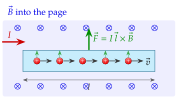
Note that the result contains the current and not the sign of the carriers: in copper the carriers are electrons () moving against , and the two sign changes cancel. The direction of the force is given by the right hand with the fingers along the current. A wire of m carrying A across a field of T feels N, about the weight of half a kilogram. This is the force that drives every electric motor (Application 4.1.2).
Trying to find the direction of the force on a copper wire by thinking about the electrons, and forgetting that they carry a negative charge. The force on the wire is with along the conventional current. A positive carrier moving with and a negative carrier moving against are pushed to the same side, which is exactly why the Hall effect (Application 4.1.1) is needed to tell them apart.
A horizontal wire runs from west to east carrying A. The Earth's field at the place has the horizontal component μT pointing north. What is the force on m of the wire?
east, north, so points up (east north up). mN, a vertical force far too small to notice against the weight of the wire.