Section 4.1 · Problems · 1 of 8
Problem 4.1.1: Infinitely long thin wire (Biot–Savart)
Infinitely long thin wire (Biot–Savart)
#Suppose that there is a constant current flowing along an infinitely long thin wire located on the -axis. Write the density of current and find the explicit expression of the magnetic field at a normal distance from the wire.
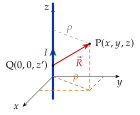
Biot–Savart's law, summed along the wire. The key observation is that every element of the wire contributes in the same direction at P, so the vector integral becomes a scalar one. The integral is the same one that gave the field of the infinite line charge in Problem 3.1.1.
The wire is unchanged by translations along and rotations about , so the field cannot depend on or . We therefore take the field point at P in cylindrical coordinates and expect .
The wire is thin and lies on the -axis, so the current is confined to :
and the volume element of Biot–Savart's law collapses to a line element, .
The source point is Q. From Q to P (Figure 4.1.18a),
because and (Section 2.3). Every element of the wire therefore contributes in the same direction , whatever : Biot–Savart's law leaves one component only.
With the integral is
so that
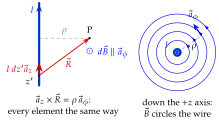
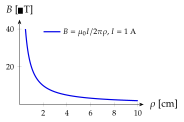
Units: is (H/m)(A)/m (V s/A)(A)/m V s/m T. Direction: the right hand with the thumb along curls the fingers in the sense (Figure 4.1.18a). A second route: on a circle of radius centred on the wire is tangential and of constant magnitude, hence Ampère's formula gives , the same result in one line, which is Problem 4.1.4. The field falls off as , not , for the same reason as the field of a line charge (Problem 3.1.1): moving away one sees more of the wire at once. The result does not depend on , because the wire is infinite and every cross-section is equivalent. Numerically, A gives μT at cm and μT at cm (Figure 4.1.18b).