Section 4.1 · Further exercises · 19 of 20
Exercise 4.1.19: Rogowski coil
About the further exercises of Section 4.1
Twenty further exercises in the spirit of the problems, the worked examples and the home exercises, graded from easy to harder within each group. Exercises 4.1.1–4.1.10 belong to the theory of Lecture 8 (the Lorentz force, Biot–Savart's law, flux, force and the vector potential) and Exercises 4.1.11–4.1.20 to the exercise session of Lecture 9 (Ampère's law, coils and rotating charges, measuring and shaping fields). They use only
the two results of the section, for a long straight wire and on the axis of a loop, and superposition.
Rogowski coil
#cf. Application 4.1.3
A Rogowski coil is a long flexible solenoid with turns per metre of cross-section cm, closed into a loop around a conductor that carries . (a) Show from Ampère's law that the total flux linked by the coil is , whatever the shape of the loop and the position of the conductor. (b) Find the induced voltage for a A rms, Hz current. (c) What does a conductor outside the loop contribute?
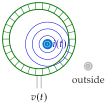
Each small group of turns links the flux of the local field along the tangent of the loop, and summing round the loop turns the flux linkage into , which Ampère's law fixes. The voltage then follows from Faraday's law, , quoted here from the next chapter.
Let be the arc length along the coil's axis (the closed curve ). In the element there are turns, each of area small enough that is uniform over it. The turns are perpendicular to , so each links the flux with the tangent of . The total flux linkage is
by Ampère's law. Only the enclosed current enters: the shape of and the position of the conductor inside it are irrelevant.
μH (the mutual inductance between conductor and coil). For , A/s, hence
An integrator restores a signal proportional to itself.
A conductor outside contributes to at every point of the coil, but for it: its contributions cancel around the loop, and the coil does not see it.
Units: is (H/m)(1/m)(m)(A) H A Wb. The coil contains no iron, so it neither saturates nor retains magnetisation: the same coil reads A and a kA fault current. The return lead is brought back through the middle of the winding so that the loop as a whole encloses no area of its own and does not pick up the flux through the big loop. A clamp meter is the same principle with a split iron core and a Hall sensor (Application 4.1.3).