Section 4.1 · Home exercises · 1 of 7
Home exercise 4.1.1: Square loop
Square loop
#A square loop of side lies on the -plane with its centre at the origin and carries a constant current . Using Biot–Savart's law on each of the four straight segments, find the magnetic field at the centre of the loop. Compare the result with the field at the centre of the circular loop of Problem 4.1.2 when .
Source: D. K. Cheng, Field and Wave Electromagnetics, 2nd ed., Example 6-5.
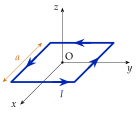
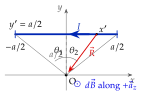
Biot–Savart's law on one straight side, from its midpoint distance to O. All four sides circulate the same way round O, so each gives the same vector along and the total is four times one side. The integral is that of Problem 4.1.1 with finite limits.
The four sides are carried into each other by rotations of about the -axis, which leave O fixed, so they contribute equal vectors at O. Each contribution is perpendicular to the plane of the loop (every with both vectors in the -plane is along ), and with the current circulating counter-clockwise seen from all four point along .
Take the side lying on , parallel to the -axis, carrying in the direction (Figure 4.1.26). With , the vector from the element at to O is , and . Then
In general a straight segment at the distance gives , with the angles under which its ends are seen from the foot of the perpendicular (Exercise 4.1.4). Here and , so .
Units: is T. Comparison: the circular loop of Problem 4.1.2 with gives . The ratio is : the inscribed circle, whose current is everywhere at the distance , produces about more field than the square, whose corners are further away (). Numbers: for cm and A, μT, against μT for the circle of radius cm. Exercise 4.1.10 extends this to a point on the axis of the square.