Section 4.1 · Home exercises · 7 of 7
Home exercise 4.1.7: Infinitely long solenoid
Infinitely long solenoid
#An infinitely long solenoid has closely wound turns per metre, each carrying a current . Apply Ampère's formula to the rectangular path shown in the figure (one side of length inside the solenoid, the opposite side outside) and show that
independently of the radius of the solenoid and of the position of the path.
Source: D. K. Cheng, Field and Wave Electromagnetics, 2nd ed., Example 6-3.
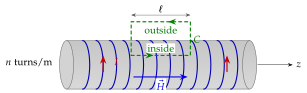
Symmetry leaves only . A rectangle with both long sides outside shows that is the same everywhere outside, hence zero, and a rectangle with both sides inside shows that is uniform inside. The straddling rectangle then threads turns and gives the value.
The solenoid is invariant under translation along and rotation about , so depends on only. For closely wound turns the current is a cylindrical sheet at . Each turn is a loop whose field is along on the axis. By the symmetry of the sheet, everywhere (no net axial current is enclosed by any coaxial circle) and (it would violate ). Hence . Far from an infinitely long sheet the field must vanish, and since cannot vary with outside (next step) it is zero everywhere outside.
Take a rectangle with both long sides outside, at and . No current threads it, the short sides are perpendicular to , so : is the same at every , hence equal to its value at infinity, zero. The same argument with both sides inside shows that is uniform inside.
Now one side of , of length , is inside and the other outside. Traverse it so that the inside side runs along . The two short sides contribute nothing (), the outside side contributes nothing (), so
because the rectangle is pierced by turns, each carrying in the same sense.
The result contains neither the radius nor the distance of the path from the wall.
Direction: with the current circulating counter-clockwise when seen from , the right hand gives along inside. Units: (turns/m)A A/m. Numbers: m and A give kA/m and mT in air. The uniform interior field is why the solenoid is the standard source of a known , and per turn gives its inductance per unit length, , in the next chapter. A finite solenoid differs only near its ends, where field lines leak out (Home exercise 4.1.2): at the centre of a solenoid whose length is five times its diameter the field is already within of .