Section 4.1 · Further exercises · 7 of 20
Exercise 4.1.7: Flux through a rectangle near a long wire
About the further exercises of Section 4.1
Twenty further exercises in the spirit of the problems, the worked examples and the home exercises, graded from easy to harder within each group. Exercises 4.1.1–4.1.10 belong to the theory of Lecture 8 (the Lorentz force, Biot–Savart's law, flux, force and the vector potential) and Exercises 4.1.11–4.1.20 to the exercise session of Lecture 9 (Ampère's law, coils and rotating charges, measuring and shaping fields). They use only
the two results of the section, for a long straight wire and on the axis of a loop, and superposition.
Flux through a rectangle near a long wire
#cf. magnetic flux
A long straight wire carries A. A rectangular loop of sides m (parallel to the wire) and cm lies in the plane of the wire, its near side at the distance cm. (a) Find the flux through the loop. (b) Evaluate it. (c) Show that the same flux follows from with .
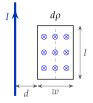
In the plane of the wire is normal to the loop, so the flux is a one-dimensional integral over strips. For (c) only the two sides parallel to contribute to the line integral.
In the plane of the wire is normal to the loop (into the page in the figure). Take strips of width and length :
, so Wb μWb.
has only a -component, so only the two sides parallel to the wire contribute to . Going round the loop so that its normal is (right-hand rule), the near side at is traversed along and the far side at along :
the same flux. The far side, where is smaller, subtracts less than the near side adds, and the flux is their difference. The ends of the loop are perpendicular to and contribute nothing.
Units: is (H/m)(A)(m) Wb. This flux divided by is the mutual inductance between the wire and the loop, μH, a notion of the next chapter. That is determined only up to a gradient (the constant one may add) does not matter: it drops out of the closed line integral. Exercise 4.1.9 derives this .