Section 4.1 · Worked examples · 1 of 4
Worked example 4.1.1: Parallel wires and the ampere
Four short calculations tied to the applications. They use only , its wire form and the long-wire field of Problem 4.1.1, with no new physics. Constants used: H/m ( H/m) and C. A good way to use them: read the given quantities, produce the formula from the Lorentz force or from Problem 4.1.1 yourself, and only then put the numbers in.
Parallel wires and the ampere
#cf. Problem 4.1.1
Given. (i) Two long parallel wires in vacuum, m apart, A each. (ii) Two busbars cm apart, braced every m, at a kA short-circuit current.
Find. (a) for the A pair, (b) its link with the definition of the ampere, (c) and the force on a m span of busbar, (d) that force as a mass per metre.
Wire 1 makes the field at the position of wire 2 (Problem 4.1.1). Wire 2, carrying in that field, feels . Since , , directed towards wire 1 for parallel currents (attraction) and away from it for antiparallel ones (Figure 4.1.34).
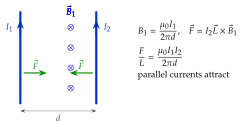
Check N/m, then press Busbars for 200 N/m. Flip a current to make the wires repel.
With H/m,
Until 2019 this was the definition of the ampere: the current that produces N per metre between two such wires. That definition made exactly H/m. Since 20 May 2019 the ampere is fixed by the elementary charge, C, so became a measured quantity: H/m (CODATA 2018), above by in relative terms, irrelevant for engineering.
scales as :
kg per metre of bar.
The defining force is minute, μN on ten metres of wire, yet : at a kA fault the bars push on each other with the weight of kg per metre, which is why switchgear busbars are braced. Home exercise 4.1.3 does the same calculation for a segment of finite length.