Section 4.1 · Problems · 4 of 8
Problem 4.1.4: Infinitely long thin wire (Ampère)
Infinitely long thin wire (Ampère)
#By using Ampère's formula, find the magnetic field at a normal distance from an infinitely long thin wire having a current of flowing along the -direction.
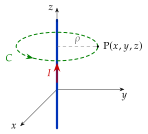
The symmetry argument of Section 4.1.8: only survives, so on a circle round the wire is constant and tangential, and Ampère's formula gives it in one line. This is the magnetic counterpart of Problem 3.2.1.
Translation along and rotation about leave the wire unchanged, so cannot depend on or . A radial component would make over a coaxial cylinder, contradicting . A -component is excluded by the mirror symmetry of the field of a line current (and, directly, by Biot–Savart's law, whose has no -component). Hence
, so through any plane const.
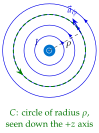
Take to be the circle const in a plane const, traversed in the sense (right hand along ). On , is constant and is parallel to :
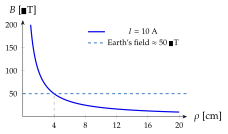
Drag the circle and check that stays equal to . Where does 10 A give the Earth's 50 μT?
The same result followed from Biot–Savart's law integrated along the wire in Problem 4.1.1, with a page of algebra instead of one line: that is what symmetry buys. Direction: is given by the right hand, thumb along (the current), fingers curling in the sense of . Units: A/m. Numbers: A gives μT at cm, and A matches the Earth's field ( μT) at cm (Figure 4.1.21b). Read backwards, is the principle of the clamp meter and of the Rogowski coil (Application 4.1.3).