Section 4.1 · Further exercises · 10 of 20
Exercise 4.1.10: Field on the axis of a square loop
About the further exercises of Section 4.1
Twenty further exercises in the spirit of the problems, the worked examples and the home exercises, graded from easy to harder within each group. Exercises 4.1.1–4.1.10 belong to the theory of Lecture 8 (the Lorentz force, Biot–Savart's law, flux, force and the vector potential) and Exercises 4.1.11–4.1.20 to the exercise session of Lecture 9 (Ampère's law, coils and rotating charges, measuring and shaping fields). They use only
the two results of the section, for a long straight wire and on the axis of a loop, and superposition.
Field on the axis of a square loop
#cf. Home exercise 4.1.1
A square loop of side in the -plane, centred at the origin, carries . (a) Find at the point on its axis, using the segment formula of Exercise 4.1.4. (b) Check the limits (Home exercise 4.1.1) and (dipole). (c) Evaluate for cm, A, cm, and compare with the circular loop of radius at the same height.
Adapted from: B. M. Notaroš, Electromagnetics, Problem 4.1.
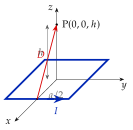
Each side is a finite segment seen from P at the distance from its midpoint, so Exercise 4.1.4 gives its field. The contributions of the four sides are tilted symmetrically about the axis, so only their axial components survive.
Take the side . The perpendicular from P to the line containing it meets it at the midpoint , at the distance . Seen from P the two ends are at the angles with , so by Exercise 4.1.4 the side produces
directed perpendicular to the plane containing P and the side, i.e. tilted from the axis by the angle with . The components perpendicular to the axis cancel between opposite sides, and the axial components of the four sides add:
: , the result of Home exercise 4.1.1. : with , the dipole field with the moment current area, the same far field as the loop of Problem 4.1.2 with .
m and m:
against μT at the centre () and μT for the circle of radius cm.
Units: is T. At the centre the inscribed circle beats the square by (its current is nearer). Half a side away the square is ahead by (it carries more current, against , and the extra length at the corners starts to count). Far away only area matters and the square, with , wins by . The dipole formula would give μT at cm, three and a half times too much, since is not "far".