Section 4.1 · Problems · 3 of 8
Problem 4.1.3: Rotating charged disk
Rotating charged disk
#Let the disk carry a static surface charge distributed uniformly with a density of and be rotated about the -axis with constant angular velocity . (a) Write the density of the corresponding current. (b) Find the magnetic field created at the point .
Source: B. M. Notaroš, Electromagnetics, Problem 4.5.
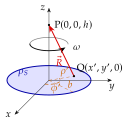
A charge that moves is a current. A point of the disk at radius moves on a circle with speed in the direction, so the disk is a nest of concentric current loops, all coaxial with the -axis. P lies on that axis, and the on-axis field of one loop is known from Problem 4.1.2: integrate it over the rings.
The disk is invariant under any rotation about , and P is on the axis: only can survive at P (Problem 4.1.2).
The velocity of the charge at is , hence the surface current density is
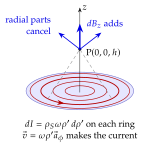
As a volume density, . The current crossing a radial segment of length is : this is the current of the ring between and (Figure 4.1.20a). Moving charge is current, and the disk is a nest of concentric loops.
Each ring is a loop of radius carrying , and by Problem 4.1.2 its field at P is along :
Every ring is coaxial with the same axis, so the radial parts cancel and the -parts simply add:
Substitute , so that and :
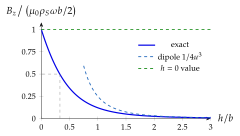
Units: is (H/m)(C/m)(1/s)(m) (H/m)(A/m) T. Two limits. : , which is , the sum of the centre fields of the rings. : expanding the bracket, it tends to , so with , the field of a magnetic dipole. Far away a spinning charged disk is indistinguishable from a small current loop of that moment (Figure 4.1.20b). For a disk in air cannot exceed μC/m, and with cm at rpm ( rad/s) this gives nT at the centre, about of the Earth's field. That is why Rowland (1876) needed an astatic magnetometer to prove that convection current is magnetically equivalent to conduction current.